It’s been a while since an agitated man wearing guns has demanded I leave a hotel conference room. In fact, I’m pretty sure the Customs and Border Patrol job fair at the Double Tree by Hilton Hotel Colorado Springs (1775 E. Cheyenne Mountain Boulevard) on July 7 was my first time.
But covering federal immigration enforcement and community response to it has led to a number of firsts for me. For example, last month I did a ride along with with Migra Watch, an organization assisting persons affected by encounters with Immigration and Customs Enforcement (ICE). “Migra” is Spanish slang for immigration authorities.
The volunteer I rode with delivered groceries from the no-cost People’s Grocery, saving one household the potential risk of going to the supermarket. The volunteer didn’t know the particular circumstances of this household and if detention was a concern. But in Trump’s America, amid Stephen Miller’s immigrant deportation sweep, there are people who are not criminals who are afraid to leave their homes even for a trip to King Soopers. Migra Watch delivers groceries to some of them in and around Colorado Springs.
During the ride along, the volunteer told me there would be an ICE job fair at the hotel and Migra Watch was planning a protest outside it. I later learned that it was actually a Customs and Border Patrol (CBP) job fair – not ICE.
It’s understandable that a layperson might conflate the two separate agencies. Both CBP and ICE are under the Department of Homeland Security (DHS). In general, CBP secures U.S. borders and ports of entry, while ICE works within the U.S. interior. However, they do sometimes work together.
For example, the two agencies worked together during the high-profile Operation Metro Surge in Minneapolis last January. During that operation, two CBP officers killed protester Alex Pretti by shooting him multiple times, just two weeks after an ICE agent shot and killed legal observer Renee Good. DHS was quick to defend the use of lethal force in both instances.
While the likelihood that any conflict would occur at the Double Tree seemed very low, I decided it would be best not to attend this job fair/protest alone. My friend and fellow reporter Seth Palmer Harris agreed to meet me there.
I arrived at the hotel on the first day of the three-day job fair, a hot and hazy Tuesday afternoon. The nearby mountains were partially obscured by smoke from the Aspen Acres fire burning to the south.
I didn’t see any protesters outside the hotel when I arrived, and I wondered if that was because it was too hot – crossing the parking lot felt like walking across a frying pan. (The protesters showed up a short time later). The air conditioning inside the hotel was sweet relief.
The event room nearest the lobby had stanchions leading to the door and a sign advertising the job fair. Just inside the room were walk-through metal detectors. A half dozen or so men stood about, some in uniforms, some with weapons. Some uniforms identified the wearer as Border Patrol, but more appeared to be private security.
A man asked if I was an applicant, and I identified myself as press. The group of uniformed men, some with guns, looked uncomfortable. They had me go through the metal detector, and then told me to stand in a corner near the door and wait. I did as asked, and took a picture. Another man told me not to take pictures in the room.
I stood in my corner for maybe five minutes watching the uniformed men talk. No applicants came in the room. Eventually a woman in business casual approached and asked what outlet I was with and what I wanted.
She was polite but I believed I saw wariness on her face. “What are your intentions?” her eyes seemed to ask. “Do you mean well or are you here with some agenda?” I tried to telegraph earnestness and good will in response.
I told her I wanted to see the job fair and what it was like, talk with a couple job fair staffers and some applicants. She told me no one there was authorized to speak to the press, but they could send me a press release. She and another man got my email address. I never received an email from them, but I found this press release about the job fair on CBP’s website.
The woman told me they were fine with me interviewing applicants and I was sent on my way.
Here are some questions I did not ask because they told me no one would answer any questions, and because I was pretty sure asking anyway would get me escorted from the premises:
- Why did I have to wait in a corner even after I went through a metal detector and was surrounded by armed men?
- It looked to me like my presence made them nervous. Did my presence make them nervous? If so, what possible scenarios were they imagining to make them suspicious of me?
- As DHS employees, what do they make of the concerns so many have right now with federal immigration enforcement regarding civil rights violations, lethal use of force, detention center conditions, and racial profiling?
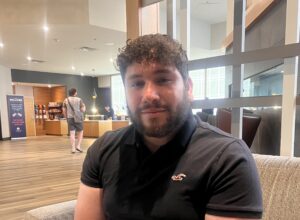
Seth got there soon after I left the room where I’d stood in the corner. I gave him the short version of what had just happened. He suggested we walk around the hotel and have a look at what else was going on with the job fair. The stanchions stretched down the wide hall and several event rooms appeared in use.
At the end of the hall, there was a room with open double doors and an opening in the stanchions for easy access. Inside, there were tables with displays on various Border Patrol job opportunities. We went in, and a man in a Border Patrol uniform welcomed us. He talked to us for a few minutes about his work in the Border Patrol, and all the options in the agency. Looking my way, he said they especially needed to hire more women.
Then another Border Patrol agent approached and gruffly asked us what we were doing there, and expressed frustration that we were in this room when we were press and not applicants. He wore holstered guns and I kept noticing how new and shiny they looked.
He commanded us to leave the room, which we did. In the hall, he grilled us.
“How did you get into that room?” he asked in an agitated voice.
We explained we had walked through the open double doors.
“If there was a sign saying not to go in there, we wouldn’t have gone in,” I assured him.
The man said there was a sign down the hall explaining the process of going into the first room (the one where I stood in the corner) and then into the second one (where we had just been) only if cleared.
“Oh,” I said. “I must have missed that.”
After the agent finished giving us a talking to, we went back and checked the lobby for the sign he said was there. There was no such sign.
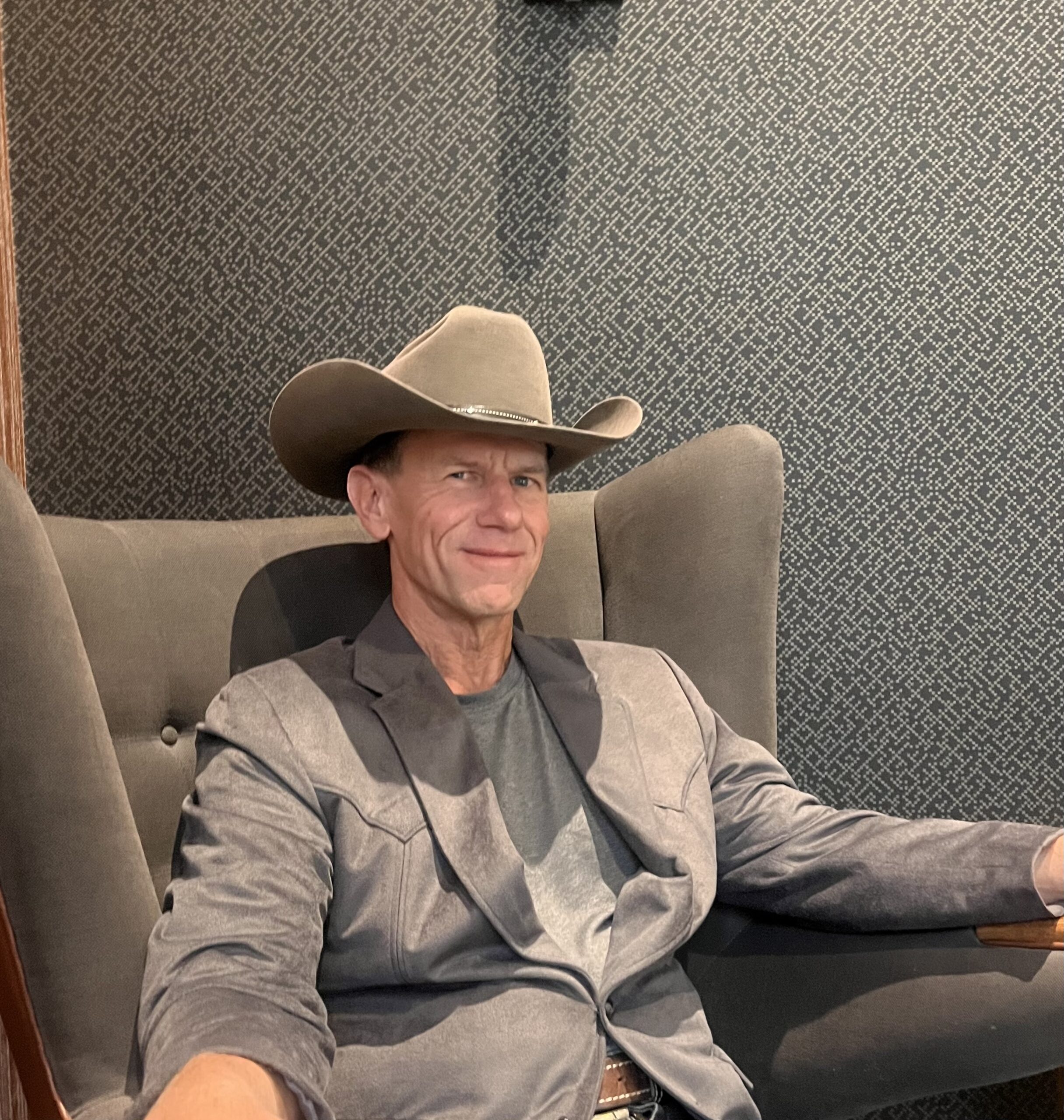
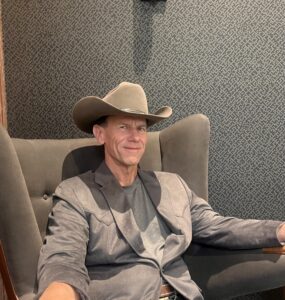
There was, however, a man in a blazer and cowboy hat, looking like he’d just walked off the set of Yellowstone. He was chuckling over our interaction with the agent, and how worked up the agent had been over us walking into an event room inside a hotel that had open doors and no signs saying not to go in. The man in the cowboy hat commented that Seth and I did not look at all threatening. (If there was a survey, I believe at least 99.99% of respondents would agree with this assessment.)
The man, as we discovered in conversation, was Christopher Mitchell, American Constitution Party candidate for Congressional District 5. You can read about him and his candidacy on his website, PatriotCowboyRevolution.com. He was there to apply for a position with the Border Patrol. He agreed to an interview.
Read the interview with Border Patrol applicant Christopher Mitchell, “A candidate for Border Patrol (and Congress),” here.
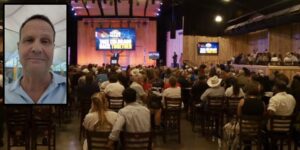
We also spoke with another applicant, a young father, Richard Camancho, who hoped to provide for his family and change the system from the inside to help people like his childhood friends, who were recently deported.
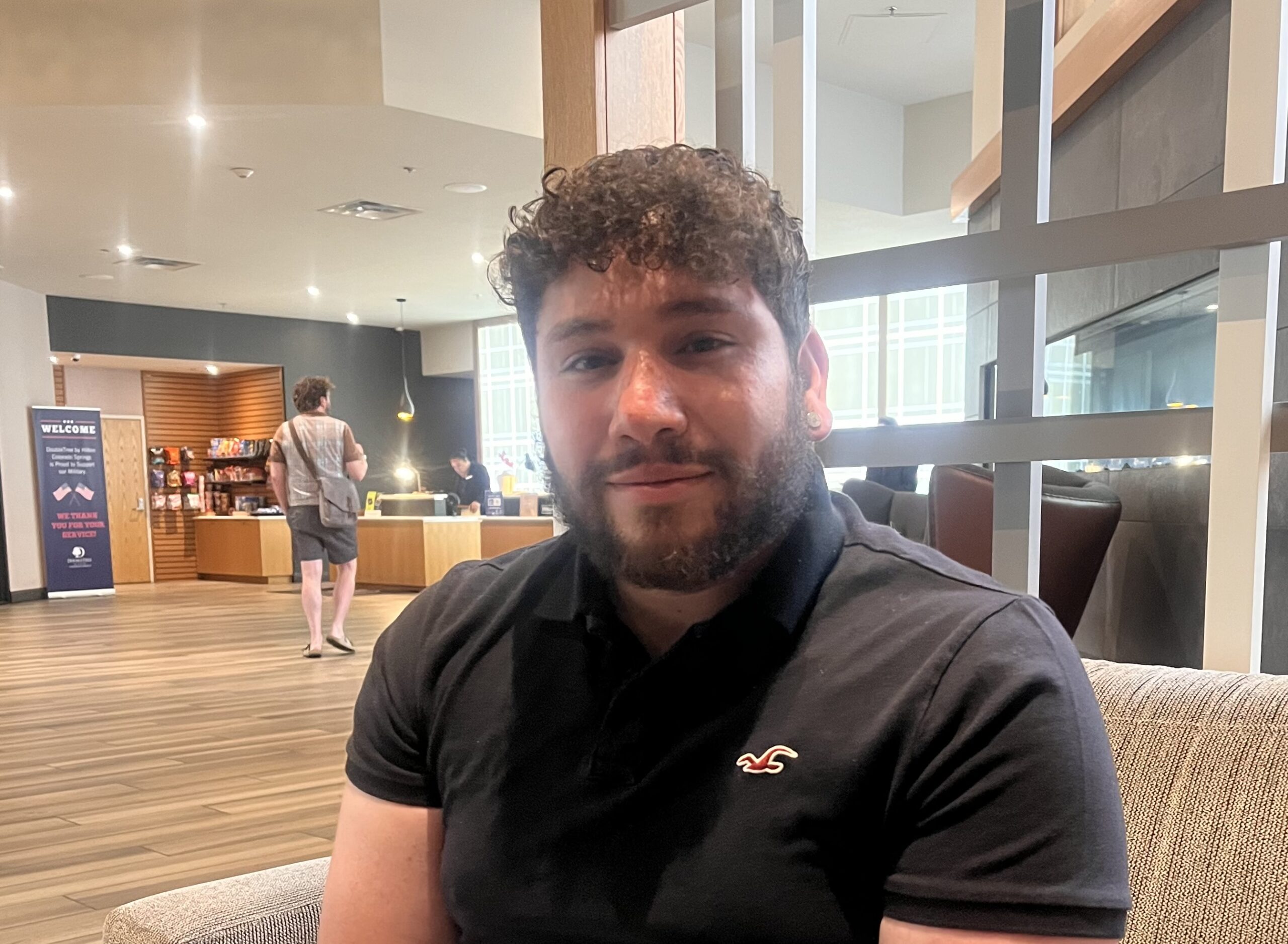
Read the interview with Border Patrol applicant Richard Camacho, “He and his friends once dreamed of joining Border Patrol. Then his friends were deported” here.
The protest
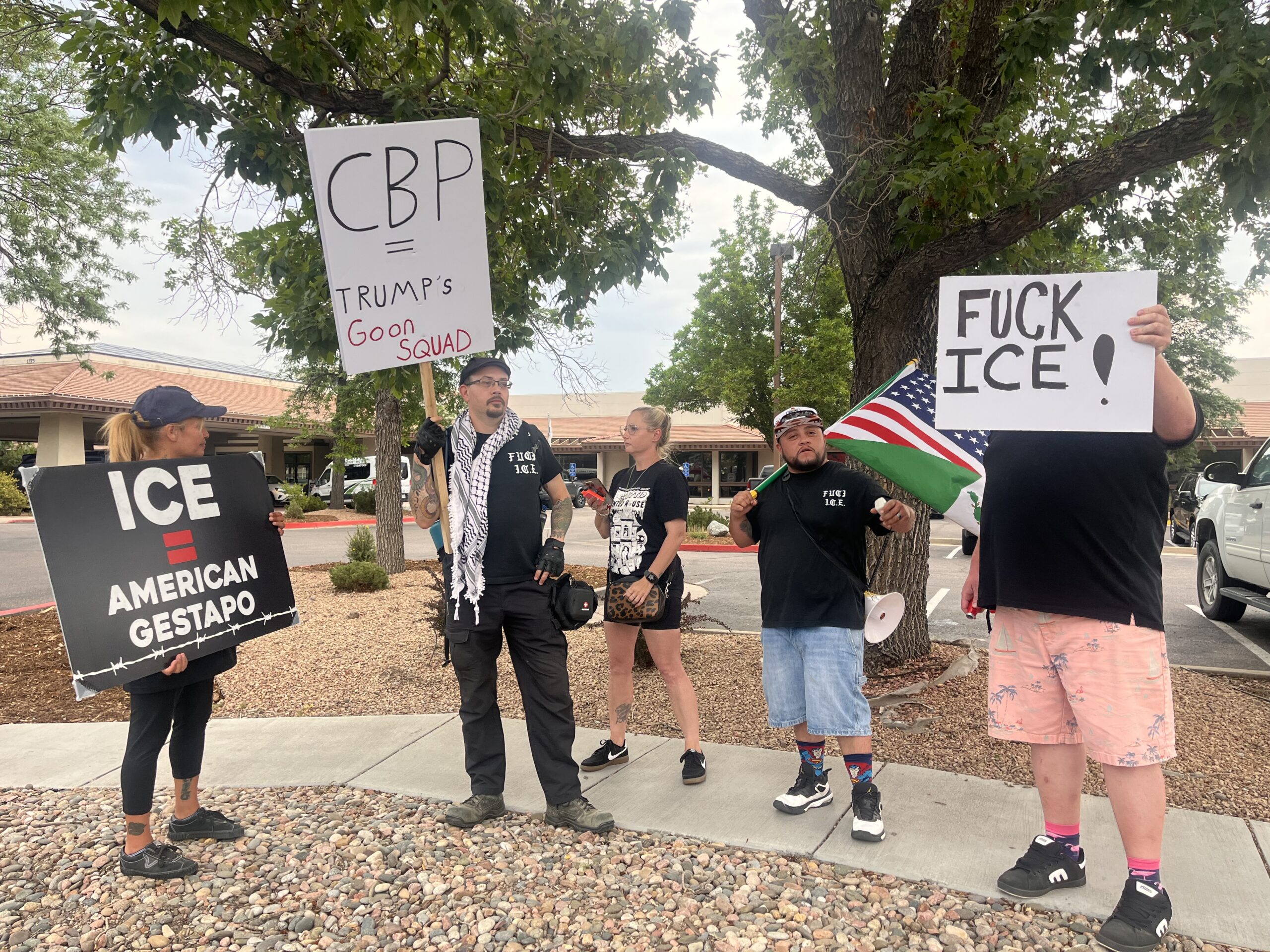
By the time we’d finished talking with Mitchell and Camacho, about a dozen protestors lined the sidewalk outside the Double Tree. Many held signs with messages like “CBP = Trump’s Goon Squad” and “ICE is Trump’s Gestapo.”
As noted earlier, CBP and ICE are separate federal immigration enforcement agencies, though both are under DHS.
One job fair protester held a sign reading “Justice for Alex Pretti.” Minnesota prosecutors say possible charges related to Pretti’s death have been hampered by the federal government’s obstruction.
Leading the protest was army veteran and Migra Watch volunteer Mel Flores. He spoke into a mic against federal immigration agencies while waving a Mexican-American flag.
Flores previously faced three Class 2 misdemeanor charges for allegedly obstructing ICE; those charges were dropped as part of a plea in a separate case of obstructing a roadway during a protest. The legal issues have not curbed his activism.
“Customs and Border Patrol thinks they can come and recruit our kids and neighbors and do it peacefully – absolutely not,” Flores said. “We’re gonna shame them as they’re here; we’re gonna shame anybody walking in, and we’re gonna shame and probably tell their moms.”
Flores said he had not spoken with any of the applicants or Border Patrol agents.
“They give us great looks, though,” he said. “Trust me, we could definitely see them walking in that door right over there … and yeah, they’re pretty vocal about how they feel as well.”
Colorado Times Recorder first covered this event.
Seth Palmer Harris contributed reporting to this story.