In a city as enthused about outdoor recreation as Colorado Springs, over 70 volunteer members of the El Paso County Search and Rescue team are on standby to assist the community if there’s trouble on the trails.
“We have people from all different walks of life … w hich is a true benefit,” EPCSAR spokesperson Chris Valentine said.
“We have people who are physicians, who are medical directors. We have engineers, people who help maintain our vehicles and people who help with our finances. We have people who, you name the career – we have folks doing that.” Valentine continued.
As it notes on its website, “As a 501(c)(3) non-profit organization, the team depends upon contributions from individuals, groups, firms and agencies interested in supporting its work. EPCSAR does not receive regular funding from local, state or federal governments, and is staffed 100% by non-paid professionals that respond 24 hours a day, 7 days a week every day of the year. There is never a charge for services.”
The website also notes that “EPCSAR provides search and rescue services primarily in El Paso County, Colorado, under the authority of the El Paso County Sheriff. However, the team also responds to requests for assistance from other counties through a cooperative arrangement with the Colorado Search and Rescue Association (CSAR).”
The Pikes Peak Bulletin caught up with EPCSAR at its biggest annual fundraiser of the year: the Annual Rescue Run, held on New Years Day with 5k and 10k options.
Valentine said each of this years’ 1,148 runners assisted the team greatly with the cost of their rescues.
“We never charge for our services. We don’t want anybody to pause and not call us because they think it will cost money,” Valentine said, “So we do things like this to raise money to be able to pay for a company vehicle … and pay for our equipment. As the volunteers … we buy our jackets and our radios and things like that.”
In the center of the parking lot amid the sea of runners and volunteers, Valentine pointed to a rigged-out vehicle that somewhat resembled the car from Ghostbusters.
According to him, the bright orange truck is a fellow team member’s vehicle; a personal investment to make the lives of the hardworking crew easier.
“We all have a real passion for the mission. People frequently invest their own money into the team,” Valentine said.
According to the team, in 2024 EPCSAR responded to roughly 160 calls to service. When a call comes in, available team members have a chance to respond. While missions can be as simple as picking up a cold hiker atop of Pikes Peak, they can also be extremely treacherous –from broken limbs to missing persons.
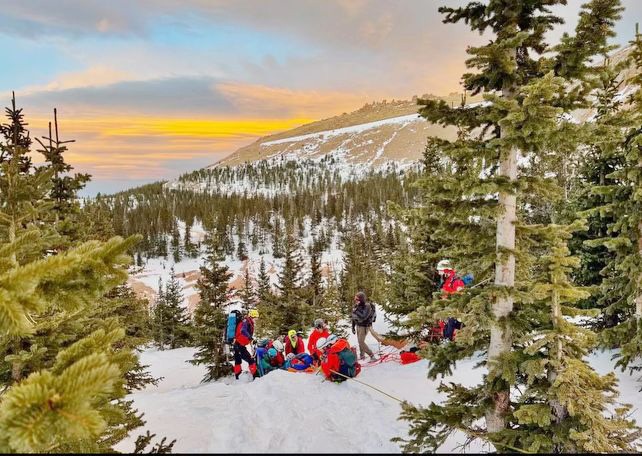
“Everyone on the team carries a passion for the outdoors and for helping people. That’s what we’re here for,” Valentine said.
While there are more extreme instances within the missions of the EPCSAR, Valentine said most often people just aren’t fully prepared to be outside, resulting in injury or situation that could have easily been avoided with better planning.
We don’t want anybody to pause and not call us because they think it will cost money. – EPCSAR spokesperson Chris Valentine
Valentine recommended that those venturing away from society bring along “the 10 Essentials,” which include navigation tools, sun protection, a first aid kit, a way of making a fire, a light source like a flashlight, emergency shelter, extra food, water and warm clothing.
“We recommend always keeping those essentials in your pack. You hope you never need them but having them with you and being prepared could save your life,” Valentine said. “What generally happens is someone is out in the backcountry, and they don’t have the things they need – they weren’t planning to be out overnight, they were planning to be out for a certain period. Suddenly, it’s dark and it’s getting colder, and they need help.”
Newly elected El Paso County Search and Rescue President Alyssa Karpa has volunteered with Pikes Peak Rescue for the past eight years.
An avid backpacker and climber, Karpa told the Bulletin she was inspired to join the team after her sister became injured while through hiking the Appalachian Trail. It just being the two of them, Karpa was the sole person responsible for getting her sister off the trail safely.
“I remember realizing that there’s definitely a better way to get her help out here, there has to be,” Karpa said. “When I moved [to Colorado Springs], one of the first things I did was look up what search and rescue is and what existed in this area.”
While her love for the outdoors and trying experience on the trail inspired her to apply for the team, her time with search and rescue inspired her to embark on another career path as well.
“I did a lot of backpacking and climbing. That was my background. When I joined, I didn’t have any other background in anything rescue related. Since joining, I’ve become an EMT, and then I became a nurse,” Karpa said.
She reiterated Valentine’s importance of the 10 Essentials and trail preparedness and added the note to be wary of hikes above the tree line during the cold winter months.
“Above tree line, is a very different world right now than below tree line. Understand that in winter, it’s a lot more dangerous, it’s a lot colder and wind is a bigger issue. The mountains are always going to be there; you can always come back another day if conditions aren’t great,” Karpa said.
Skee Hipszky is the longest serving member on El Paso County Search and Rescue, volunteering with the team for over 52 years. He said in his more than five decades of experience, the emergence of the “armchair expert” through the rising popularity and relevance of the internet has posed bigger problems for the team in recent years.
“Today, people Google it … and they’re experts. And unfortunately, that gets a lot of people in trouble because they didn’t learn how to do it,” Hipszky said. “They just figured, ‘I’ve got a cell phone. If I need to do start a fire, build a shelter, I can Google it and I’m all set.’ Unfortunately, in the backcountry, there’s no cell coverage, right? Even with this new satellite stuff, it’s kind of iffy … You still need to know what you’re doing and be ready for it.”
He said what has kept him involved is his love for helping people and being outside.
“Being a street medic is cool, but being in the wilderness is even more interesting because it’s more of a challenge. You don’t have a five-minute wait to get into the hospital. It can be hours before I get to you. It can be hours before I can get you out. So, it’s a whole different kind of dealing with a patient,” he said. “It’s very rewarding. You know, when you get those folks back safely … you find that missing child and reunite them with their parents – all that stuff is … a reward in itself.”