Last weekend, neighbors in Stratton Meadows gathered for a planting party organized by the nonprofit Hey Neighbor, the Colorado Pollinator Network and the Fountain Creek Watershed District.
“This is our fifth Stratton Meadows planting party,” said Hey Neighbor Executive Director Kelly Bull. “We – one yard at a time, on the street and in the neighborhood – are turning our neighborhood into a food forest. We’re planting edible plants and native plants, pollinator plants, so it’s making it really beautiful, and edible, and cooler with shade. We get a bunch of neighbors together, and we also have a lot of Colorado College kids here and folks from Fountain Creek Watershed all pitching in to do it together.”
Stratton Meadows is a diverse, historically underinvested neighborhood just south of downtown Colorado Springs. The planting parties offer a low-barrier way for residents to participate in something tangible together, while addressing food access, supporting pollinators, and improving the local watershed. The partnership between Hey Neighbor, Colorado Pollinator Network and Fountain Creek Watershed District has enabled these planting parties to be grant funded, with no cost to the neighbor.
Bull’s planting parties started with her own yard. “I did my house originally as kind of a demonstration site for the neighborhood to show what people could plant, and then I actually just ran out of planting area in my yard,” she said. “I made friends with my neighbors, and a lot of people just don’t really have landscapes going on in the neighborhood, so I made friends with the neighbors on the corner first and said, ‘Hey I would love to plant your yard,’ and they were like, ‘Okay.’ So we got a grant through the Pollinator Network and then Fountain Creek Watershed helped get grants as well, and that was our first planting party.”
Alli Schuch, executive director of the Fountain Creek Watershed District, explained how Bull’s planting parties improve the entire watershed.
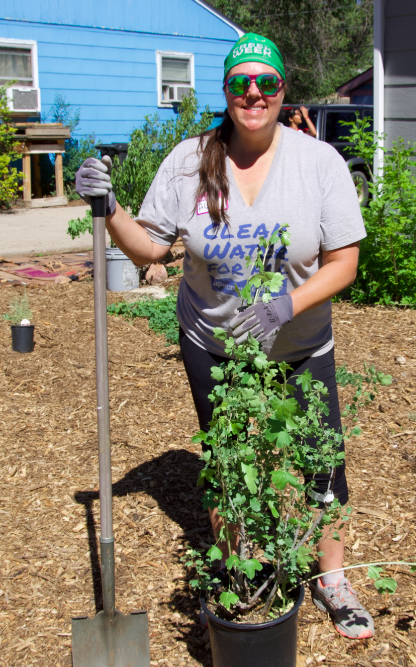
“Our mission is to protect and enhance the health of the Fountain Creek watershed,” she said. “We do that basically through two arms: One is our on-the-ground creek restoration projects – we’re talking million-dollar projects to protect Fountain Creek – and then we also do education and outreach and public engagement. This is a perfect example of neighborhoods, community coming together to really beautify [and] enhance, but also prevent stormwater pollution. The whole goal of these gardens is to capture that stormwater runoff on site because as soon as it leaves the street, all that water is gonna collect any debris, any oil that’s on the ground, dog poop, all those things get washed into our creek. So this is a beautification project, but also it’s about watershed resiliency.”
In addition to providing edible plants and absorbing stormwater, Schuch said the yards provide educational opportunities for groups like hers. “This is partially funded by the Generation Wild Coalition of the Pikes Peak Region,” she said. “That is about getting underserved youth into the environment and learning about natural resources. We’ve done a number of educational tours of this area to show these gardens off now that we have a whole bunch of them in one neighborhood. It’s really a great demonstration site for the community.”
Joel Adams, the homeowner of the site of this weekend’s planting party, helped Bull with a planting party last year. “She did that house over there and knocked on the doors and said, ‘Would anybody be interested in helping out?” and I was new to the neighborhood and I was like, ‘Sure.’ At the end of that I said, ‘How often do you do this?’ and [she said] ‘I do a house a year or a couple of houses per year to beautify the neighborhood,’ and they get money to do it, and my house could use it because I can’t grow anything in the front yard.”
Bull said once Adams’ yard is planted it will be mostly self-sufficient. “This yard is meant to be as low maintenance as possible,” she said. “It’s mostly all native, drought-tolerant [plants] that he’ll need to water for a couple months to get them established, and then they should just be fine on rainwater alone. We have choke cherries, service berries, rabbit brush, penstemon, currants, so all sorts of low-maintenance edible natives.”
Schuch said these kinds of landscaping efforts are especially important during drought conditions. “With this past winter and the extreme low snowpack that we have, people are really paying more attention to water than ever before,” she said. “We had a rain barrel sale a couple of weeks ago … A rain barrel is another really easy thing that a homeowner can do as they’re doing their part to protect the watershed.”
Schuch said watershed health relies on everyone doing what they can – whether that’s a neighborhood cleanup, planting some native plants, or transitioning away from “the very thirsty Kentucky bluegrass that we see a lot.”
“It’s really expensive for your water bill and we shouldn’t be spending our limited water budget on outdoor watering,” she said. “This [planting party] is just a great example of what’s possible – to show that even in our arid climate, you can have a beautiful front yard.”
Homeowners and gardeners interested in sustainable landscaping can find more resources on the Fountain Creek Watershed’s website.