As data centers gain steam across the United States, Colorado Springs, too, has seen several centers set up shop and several more submit requests for their power- and water-thirsty facilities used for artificial intelligence and other data computing uses.
But is Colorado Springs Utilities positioned to welcome these new data centers? What limits, if any, could be imposed on them? How much power and water would be necessary to support additional data centers?
Utilities’ policies require big users to go through a specific process of approval for both water and power, but the new wave of mega-users could overwhelm local capacities. Utilities is seeking a path forward to meet state clean-air standards as the deadline nears to close its last coal plant and the region faces the potential stress of water shortages due to drought and depletions from its chief source, the Colorado River.
“We are willing and prepared to serve any large customers that are evaluating Colorado Springs as a potential location,” Utilities spokesperson Alex Trefry said in an email, “and we have a clear process to determine what our ability to provide service would look like.”
Background
On March 10, PBS News Hour reported on the advancement of renewables at a time when data centers are gobbling up power quickly. The feature noted coal-fired plants now account for a mere 16% of U.S. power generation. While utility-scale solar is growing faster than any other power source, renewables are unable to provide the round-the-clock power that data centers require, PBS reported, with one expert saying the nation will need 50% more power in the coming 20 years.
Not surprisingly, many proposed data center projects are meeting stiff headwinds from local residents across the country due to concerns about increased carbon emissions, water use and the rising cost of power.
Techpolicy.press reported in December on the land rush by data centers, noting that a Meta data center in Georgia accounts for 10% of energy consumption in that county, while another being built in Louisiana will match the power use of the entire city of New Orleans and require three new fossil-fuel plants for its energy supply.
Here, Springs Utilities is asking state lawmakers to enact Senate Bill 26-022, which would allow the city to keep running Nixon Power Plant, possibly until 2040. Utilities previously contemplated shutting down the plant, located about 10 miles south of Colorado Springs, in 2029 in order to meet state requirements to reduce carbon emissions by 80% by 2030, as compared to 2005 levels.
Nixon represents 261 megawatts of Utilities’ roughly 1,400 megawatts of generating capacity.
Utilities CEO Travas Deal is featured in a recently released video saying he has “a plan” for the city’s energy future, but he doesn’t say what that plan consists of. Utilities has said it has no records responsive to The Bulletin’s request for a “Plan B” if Nixon is forced to shut down by late 2029.
Asked about that, Utilities spokesperson Danielle Nieves said via email, “In the video, Travas is referring to our ongoing energy planning efforts, which include our request to keep the coal-fired unit at Nixon open past 2030. We are currently in the process of updating our Electric Integrated Resource Plan (also known as our Sustainable Energy Plan), and next month we will enter the Southwest Power Pool Regional Transmission Organization. All of these efforts are what he is referring to in our plan to move forward while meeting state mandates in a cost-effective approach for customers.”
Utilities plans to add natural gas generators at its Horizon campus southeast of Colorado Springs Airport, but that effort has been complicated by concerns raised by aviation officials due to exhaust fumes that the plant would emit, as reported by the Southern Colorado Business Forum & Digest.
The requests
It may appear Colorado Springs could be ill-suited to host power-hungry data centers, but that’s not necessarily true, Springs Utilities said.
Records show that Utilities has received 10 requests in the last two years for power for data centers. Together, they seek a combined power supply total of 1,420 megawatts, about on par with Utilities’ current generating capacity.
The 10 applications for data centers show that three have been named finalists in site selection; two have been designated as being on a “short list” for site selection, and three have been named as being on a “long list.” One is an existing Utilities customer, and the other proposes a data center in an existing building, the requests state.
Trefry, the Utilities spokesperson, said the agency evaluates prospective customers through a process that includes a required intake application and a subsequent formal application accompanied by fees paid by the potential customer. Thereafter, a thorough study is conducted to evaluate system impacts and resource needs with a load at or above 5 megawatts electric or 0.25 million gallons a day of water, he said.
Customers requiring 10 megawatts or more are served through Utilities’ Industrial Service — Large-Load rate.
“This structure creates a clear process and pathway for large customers to follow, including access to power through market purchases, when needed — without shifting costs to the rest of the community,” Trefry said.
Customers must sign a 10-year agreement, are billed based on contracted load, and must provide 36 months of collateral, he said. Should Utilities be unable to provide the power needed through its own generating facilities, Trefry said the cost of purchased power is passed directly to the large-load customer.
Utilities also can provide “additional incentives” to those large customers who bring “significant value,” Trefry said, such as a large number of high-paying jobs.
“These incentives help attract major employers while maintaining fairness for existing customers,” he said.
In response to a records request for a list of customers with whom CSU currently has an agreement for special rates that are outside the scope of normal rates, Utilities demurred, citing its customer privacy policy. But Utilities did acknowledge there are three active economic development agreements — one extends through 2028, another through 2034 and a third through 2035.
Trefy emphasized that the 10 data center requests represent “exploratory inquiries” only.
What about water?
Given the growing scarcity of water, linked in part to drought and to the over appropriation of the Colorado River, which provides up to 70% of Colorado Springs’ supply, water might be a more limiting factor for data centers locally than power.
Only five of the 10 requests submitted to Utilities in the last two years stated how much water they would need. Some stated a range, and the combined total of those five ranged from 41,125 gallons per minute (GPM) to 72,667 GPM. That equates to 59.2 million gallons per day (MGD) to 104.64 MGD. That range, in turn, equates to 66,356 to 117,289 acre feet of water per year.
For perspective, Utilities currently has access to 95,000 acre feet of water, and reports usage of around 72,000 acre feet a year.
Asked about that, Trefry said, “Any request at or above 0.25 MGD triggers a large‑load water study. That study, and other steps in the process, evaluates available supply, system capacity, delivery facilities, and any needed agreements before reservation of water capacity occurs.”
In 2023, City Council adopted a rule that requires Utilities to have a water supply of 128% of demand before land can be annexed into the city, Colorado Public Radio reported, though Council could, by majority vote, make exceptions under extraordinary and critical circumstances.
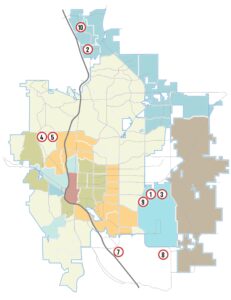 Map of proposed data centers
Here’s a map of entities that have requested power from Colorado Springs Utilities for data centers, based on records provided to the Pikes Peak Bulletin via a Colorado Open Records Act request. The companies’ names are redacted from the records, but some requests provided a preferred site. The owner of the site isn’t necessarily the entity making the power request.
Some applicants identified the stage of the site selection process by stating the project is on the long list, short list or has been named a finalist.
Key:
MW: Megawatts
GPM: Gallons per minute
Investment: The amount of money the requester (the company) says it will spend on the data center including real estate purchase and construction.
No. 1
Date of request: Nov. 3, 2024.
Site: Peak Innovation Park, Colorado Springs Airport.
Current landowner: City of Colorado Springs.
Investment: $500 million for a 500,000-square-foot facility. (On the “long list.”)
Employees: 25 to 50.
Power needs: 148 MW by January 2028.
Water needs: Not provided.
No. 2
Date of Request: March 26, 2025.
Site: 12710 Voyager Parkway.
Current landowner: Progressive Direct Insurance Co.
Investment: $40 million. Existing building.
Employees: Not provided.
Power needs: 50 MW by 2030.
Water needs: Not provided.
No. 3
Date of Request: May 27, 2025.
Site: Peak Innovation Park, Colorado Springs Airport.
Current landowner: City of Colorado Springs.
Investment: $600 million. (On the “short list.”)
Employees: 40 to 70.
Power needs: 30 MW by September 2027; 30 MW by January 2030. Total of 60 MW. (Will have 5 MW of rooftop solar.)
Water needs: 600 to 1,200 GPM.
No. 4
Date of Request: July 3, 2025.
Site: 1615 Garden of the Gods Road.
Current landowner: 3G Venture II, Inc.
Investment: $162.5 million. Existing building. (Named a “finalist.”)
Employees: 20 to 30.
Power needs: 70 MW.
Water needs: 310 to 467 GPM.
No. 5
Date of Request: June 27, 2025.
Site: 1575 Garden of the Gods Road.
Current landowner: Rockwell Telecommunications of Colorado Springs, Inc.
Investment: $100 million. Existing building. (Named a “finalist.”)
Employees: 100+.
Power needs: 90 MW by July 2026.
Water needs: 500 to 900 GPM.
No. 6
Date of Request: Oct. 15, 2025
Site: No address given. (Request states the applicant is “Existing CSU customer since 2018.”)
Current landowner: Not available.
Investment: $150 million.
Employees: 100.
Power needs: 42 MW by July 2026; 30 MW by Oct. 1, 2026. Total 72 MW.
Water needs: Not stated.
No. 7
Date of Request: Oct. 6, 2025.
Site: 3819 Janitell Road.
Current landowner: Vineyard II LLC.
Investment: $2.5 billion to $3 billion. 300,000 to 350,000 square foot building. (On the “short list.”)
Employees: 60 to 80.
Power needs: 60 MW by September 2026; 100 MW by 2028; 200 MW by 2029. Total 200 MW.
Water needs: 25 to 100 GPM.
No. 8
Date of Request: Dec. 23, 2025.
Site: Peak Innovation Park, South Marksheffel Road and Southern Colorado Rail Park on Charter Ranch Road.
Current landowner: City of Colorado Springs, Veranda Vista Investments LLC, and Southern Colorado Rail Park LLC, respectively.
Investment: $3 billion. (On the “long list.”)
Employees: 500.
Power needs: 500 MW by 2030.
Water needs: 40,000 to 70,000 GPM
No. 9
Date of Request: Feb. 19, 2026.
Site: Peak Innovation Park.
Current landowner: City of Colorado Springs.
Investment: “Unknown.” (On the “long list.”)
Employees: “Unknown.”
Power needs: 200 MW by Dec. 31, 2029.
Water needs: Not provided.
No. 10
Date of Request: June 12, 2024.
Site: 550 and 650 Sybilla Lane.
Current landowner: Novva Colorado LLC.
Investment: Named a “finalist,” currently in operation.
Employees: 50.
Power needs: 30 MW by end of 2025.
Water needs: Not provided.