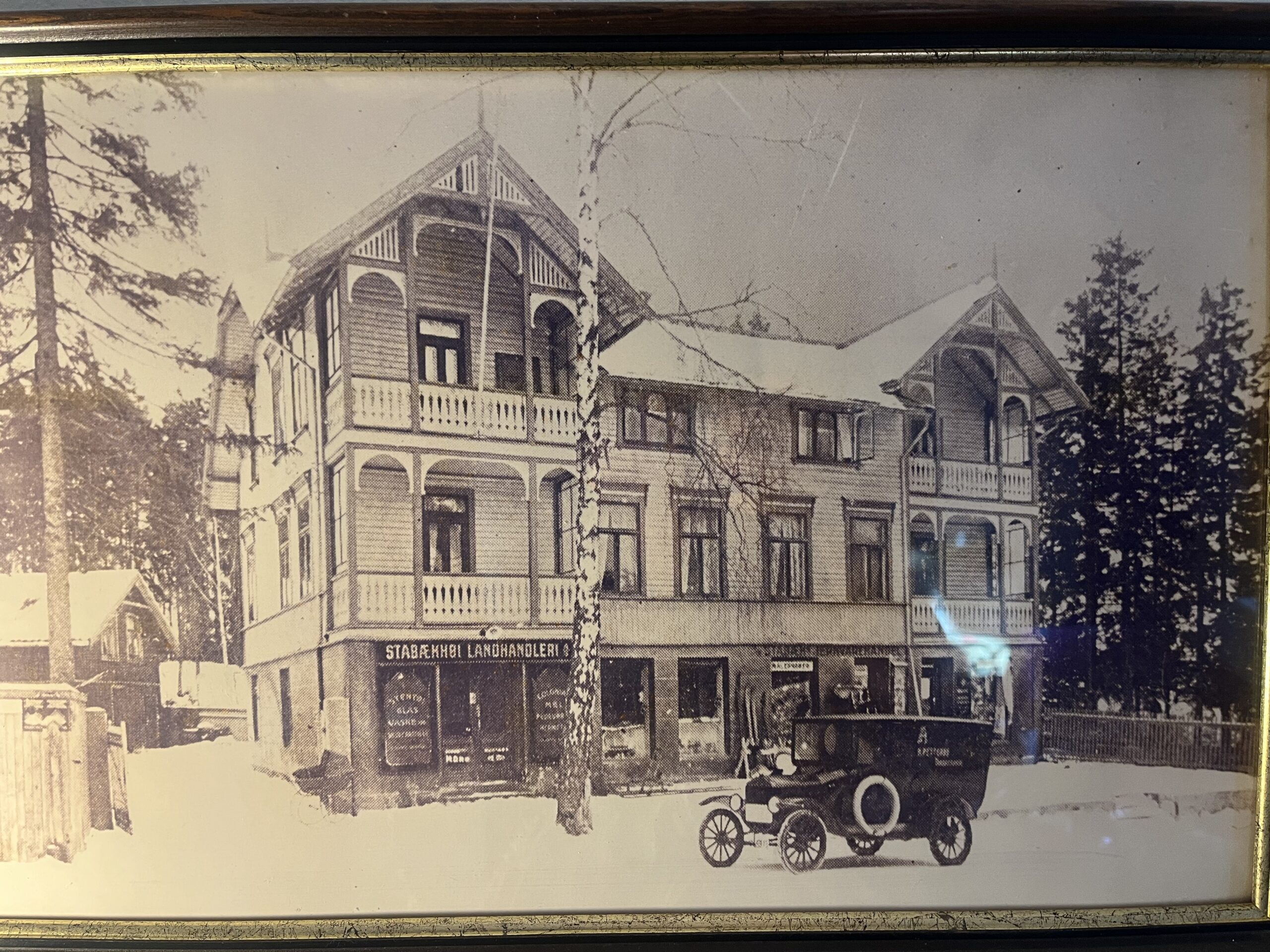
In my front room hangs an old framed photograph inherited from my mother, a Norwegian immigrant. I keep it in a prominent place to remind me that when history comes calling, I have a choice how to answer. It reminds me that our regular lives can be upended by extraordinary circumstances, and we may become true heroes, villains, or both.
I don’t know the exact year the photograph was taken, but it was around a century ago. It shows an early-model automobile in front of a three-story house; the bottom floor bears a sign in Norwegian that translates roughly to “Stabæk General Store.” Stabæk is a community west of Oslo.
When this photo was taken, the store with the home on top belonged to my great-grandparents. They ran the store, which included a butcher shop and a grocery that also sold household items. Their daughter was my grandmother.
My grandmother was a tween and teen during World War II when Nazi soldiers invaded and occupied Norway. It was a tough time for the Norwegians, many of whom struggled to meet basic needs, but my great-grandparents were able to get by better than most because of the store. They made it a point to give food to community members in need regardless of politics, even to the quislings – Nazi sympathizers and collaborators.
This generosity made them very popular. My mother said that even decades later people would approach her in the street to tell her they could not have survived the war without the help of her grandparents.
This generosity also made them above reproach, which kept them safe as they worked covertly in the Norwegian resistance movement.
My grandmother remembered being given notes to tuck in her socks and instructions on where and when to deliver them. My mother told me she heard they used the store vehicle to take people to safety in nearby neutral Sweden.
One day they were warned that someone had tipped off the Nazis and they were coming to search the house, and the family had just a short time to prepare. They shoved all their contraband under my grandmother’s bed, including an illegal radio they were really worried about being caught with – being caught with one could mean death. My grandmother laid on the bed and pretended to be sick and asleep.
As my grandmother told it, my great-grandmother really hounded the Nazi soldiers who came to search the house. She was, as my grandmother remembered her, a beautiful and fierce woman, in her 40s at that time. The soldiers, my grandmother said, were not much more than kids, in their late teens and early 20s. Her mother was probably similar in age and appearance to their mothers back in Germany.
My great-grandmother made the Nazis take their muddy boots off so they didn’t dirty her floor, and chastised them to be quiet so they would not disturb her daughter, who was ill and in bed. They started to go into the room with the hidden contraband, and my great-grandmother harped that surely they had been raised better than to go into a young woman’s bedroom.
My teenage grandmother laid in bed, feigning sleep, as a Nazi soldier shone a flashlight around the room, on her, on the bed that hid the forbidden radio.
The soldiers easily could have gone into the room, looked in obvious places, and found the radio. But they didn’t. They put their muddy boots back on and left.
My grandmother remembered her beautiful, fierce mother would cry at night because she was terrified they would be discovered and taken, put in jail, maybe killed. The fear was real, but it did not stop them.
I grew up hearing my grandmother’s stories of her family’s courageous acts, though only because I asked for them – my grandmother never brought it up on her own, and she didn’t seem particularly impressed with what her family had done. She seemed to view it all as an unpleasant but necessary chore. I was plenty impressed and always wondered what I would have done in her place, or her parents’ place.
It wasn’t until I was a young adult that it occurred to me: I knew next to nothing about my grandfather’s family.
When I was 21, I got my grandfather and I a 12-pack of beer, turned on a recorder, and started asking questions. The secrets came out.
My grandfather’s parents were quislings. As a teen, he was sent from their isolated farm in Norway to attend boarding school in Germany. He joined the Hitler Youth and was sent to fight for the Nazis toward the end of the war.
He was in Dresden, Germany, and saw it after the Allies bombed it to rubble. He spent some time in a Russian prison camp where they starved him. (Learning that gave a new meaning to his standard line when I was little and didn’t eat what was on my plate: “If you’re hungry enough, you’ll eat a rat.”). Then he went back to Norway and served a prison sentence for being a traitor, a little over a year – it was a shorter sentence because of his youth. (Once he told me that some of the worst atrocities he witnessed – Dresden being top of the list – were done by the Allies, the people on the right side of history. He said something close to, “There are no good guys who win a war. The good ones die in the war.”)
This explained for me why my grandparents moved to the United States in the 1960s and stayed, even though they missed Norway and went back for many visits. Living in their home country, he would never have escaped the quisling tarnish.
My grandparents came to East Tennessee during the civil rights movement with their three small children, my mother being one of them. They supported desegregation. For decades, my grandparents donated to the American Civil Liberties Union, the Southern Poverty Law Center, and other organizations dedicated to fighting for civil rights.
He told me he never believed in the Nazi ideology. But I don’t know if that was true, or if he just wanted it to be true.
I do know I never saw any trace in my grandfather of the hate his parents taught, though the same can’t be said for his family members, who lived an ocean away and didn’t know me.
My mother remembered my grandfather’s mother once complimenting her when she was a child by saying, “Blue eyes are good. We know there’s not any Jew in you.”
My mother went on to marry an Iranian immigrant and have brown-eyed, dark-haired, olive-skinned me. It makes me happy to think how pissed my racist great-granny, who was still alive at the time, must have been.
Out of all the things my grandmother’s parents did, one of the most surprising and heroic to me is that when my grandfather, the quisling, asked to marry their daughter, they did not object. After everything, they chose reconciliation.
I’m writing this at a table next to the picture of the house and general store where my great-grandparents discreetly resisted fascism. The children are at school and my home is quiet, but the winds of history howl like an approaching tornado.
Whatever history throws at us next, may we rise to the occasion in a way that makes our great-grandchildren proud.