An old proverb I heard as a child has stuck with me: “When an old man dies, a library burns to the ground.”
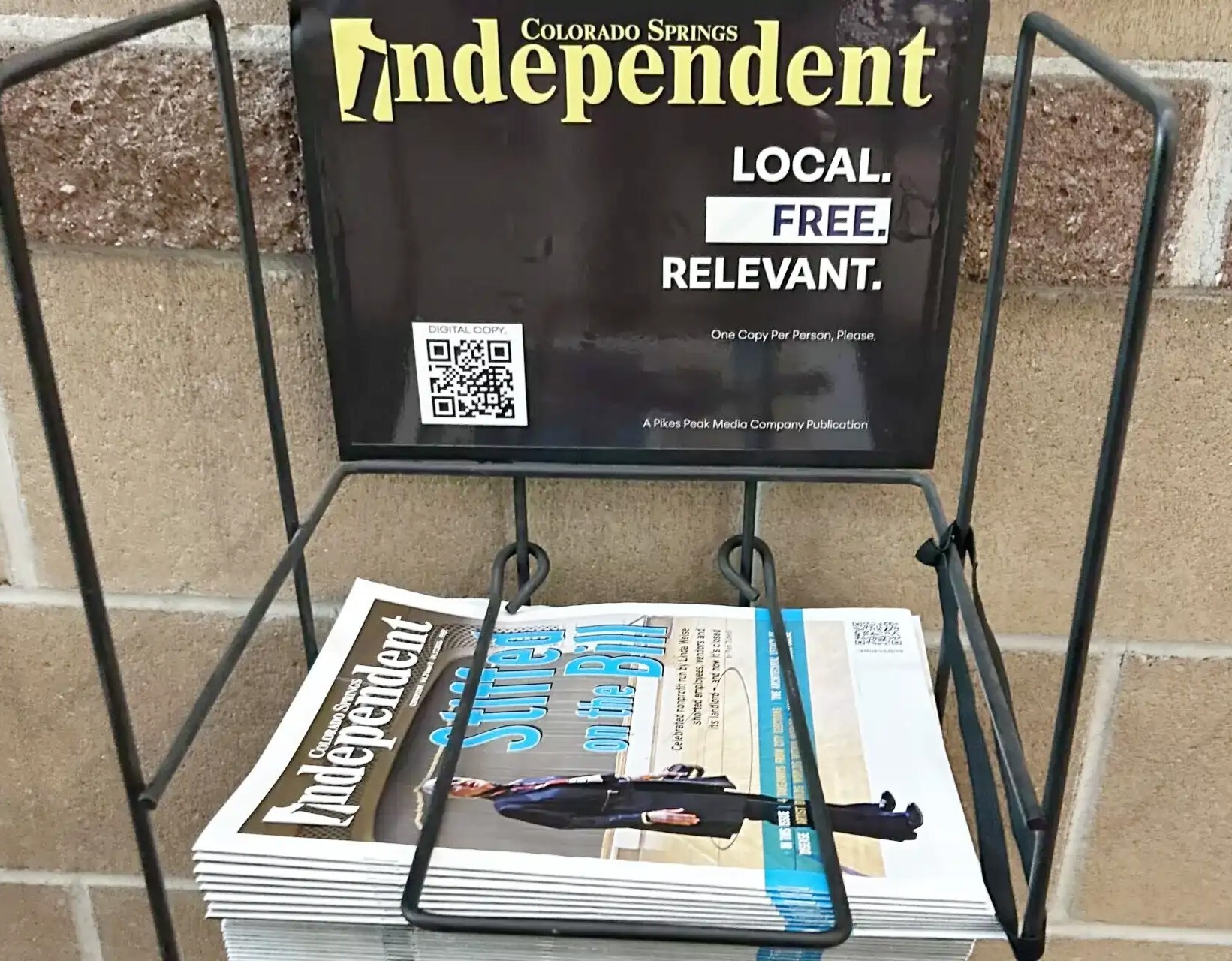
What happens when a news website dies? When the website containing the online archives of the Colorado Springs Independent – a progressive alt-weekly known affectionately as the Indy – went dark in 2023 after a poorly executed website migration, an entire historical record disappeared into the digital night. Decades of award-winning investigative journalism, arts and culture reporting, and community voices: gone.
But the owner of the Indy archives, Dirk Hobbs of Colorado Media Group, told the Pikes Peak Bulletin on Dec. 17 that the archives will be resurrected next month.
“We’re going to be making them available Jan 2026,” he texted the Bulletin.
“Haven’t determined paywall yet,” he added.
The archives will not be accessible through any of the old domains, Hobbs said, but instead, it is likely that searchable files will be housed on the ISSUU publishing platform.
Hobbs – whose media company purchased the rights to the Indy last spring after a tumultuous few years in which the Indy rebranded, un-rebranded, closed, changed ownership, and then closed again – said restoring the archives was not a top priority in the first six months of converting the former Indy to the SoCo Insider. The SoCo Insider is not an alt-weekly but a glossy culture-focused magazine that does not do investigative journalism.
“In these first six months of converting the former COS Indy to the SoCo Insider, our focus has been on our mission of showcasing regional arts, music, sports, outdoor, food, entertainment and lifestyle scenes,” said Hobbs. “We’re focused on establishing our positioning as an authoritative resource for those interests using our powerful website: https://socoinsider.com, and our digital and print editions.”
Hobbs said the Indy archives are “on a server that is in the hands of the former service provider who provided services for the owners prior to Pikes Peak Media Company” who purchased the Indy in 2024 and then closed it again after about a year of operation.
“We just need to retrieve it from them,” he said.
Several of the writers who contributed to the Indy’s vast catalog contribute to the Pikes Peak Bulletin today, including investigative reporters Pam Zubeck and Sean Beedle, and columnist John Hazlehurst.
Zubeck told the Bulletin, “While some issues of the Independent are available at the Pioneers Museum in hard copy, that hardly reflects a complete collection of the important work the newspaper did during its 30-year run.”
She noted that in just her work alone, pieces that will remain lost unless the electronic archive is revived include articles on:
- Missteps made during the 2012 Waldo Canyon Fire in which two people died due to tardy evacuation orders.
- Missteps made during a felony arrest that resulted in the death of an El Paso County deputy.
- How local law enforcement is or is not implementing the “red flag” law that allows high-risk individuals to be disarmed, possibly saving lives.
- An underground water leak that threatened homes in the Falcon area.
- Numerous stories about the Air Force Academy.
- Numerous stories about elections.
- Numerous stories about Colorado Springs Utilities.
- Stories about contamination of prime downtown land by a gas plant.
- Coverage of the City for Champions initiative.
“These and hundreds of other stories could serve as crucial background information for new coverage of issues that often do not include historical context,” Zubeck said. “Although some Indy stories triggered coverage by other news outlets at the time, many stood alone and remain the only source of this information.”
She continued, “It’s truly a disservice to the community to continue to have the Indy archive lost in the cyberworld where it remains inaccessible to anyone.”
If Hobbs’ plan comes to fruition, it won’t be entirely inaccessible for much longer – though questions of paywall and format remain. Under its original leadership, the Indy was distributed free of charge from its first issue to the last.