Norwood Development Group plans to build a luxury Catbird Hotel on the northwest corner of Moreno and Cascade Avenues, similar to the original in Denver. Norwood’s website states, “Sage Hospitality Group and Norwood Development Group have submitted a preliminary proposal to build a new Catbird Hotel in downtown Colorado Springs, at the corner of East Moreno Avenue and South Cascade Avenue. The proposed hotel, an extended-stay, full-service property, will feature 180 rooms, along with dining and meeting spaces. It will be the second Catbird Hotel, following the original in Denver, and will be part of Sage’s portfolio of independent lifestyle hotels.”
Residents of the nearby Mill Street neighborhood are concerned this project will negatively impact the character and affordability of the area – and they are seeking dialogue with Norwood on mitigating these impacts. Residents have organized as the Mill Street Community Benefits All Coalition.
The precedent this dialogue sets could potentially influence future redevelopment. Norwood is heavily involved in downtown. The group’s website cites a whopping $2.3 billion in downtown investment including hotels, apartments, restaurants and offices – plus $327 million in “tourism investment” including downtown’s Weidner Field, Ed Robson Arena, and the U.S. Olympic and Paralympic Museum.
The Coalition gave a statement to the Pikes Peak Bulletin on Dec. 29:
“The Mill Street neighborhood is Colorado Springs’ oldest working-class neighborhood, originally home to workers at the Broadmoor Hotel, servants to estates in the Old North End, and laborers at the nearby mill, and it continues to house many of the city’s essential workers to this day. Mill Street neighbors teach our city’s kids, treat our patients, bag our groceries, serve our coffee, and take care of our elders. It’s a friendly, diverse, working-class neighborhood and we like it that way.
“But today, the Mill Street we know and love is at risk – historically an affordable place to live, prices in the neighborhood are rising rapidly as upscale development takes over on the south end of downtown. In a 2022 survey of more than 70 Mill Street residents, 58% said they were concerned about being displaced, and pressure has only increased since then.
“A team of neighbors in Mill Street have come together to find solutions to this issue, including trying to work with the developers of our neighborhood to create meaningful partnerships that benefit the whole community. We’ve been in talks with Norwood Development Group about this type of partnership since the spring and are optimistic these conversations will continue and lead to real benefits for our neighborhood and community as a whole.”
Urban renewal and TIF
Norwood partnered with the Colorado Springs Urban Renewal Authority (CSURA) for the project, which includes building “attainable housing” as a second phase after hotel construction. “Attainable housing” generally means housing priced for middle-income households, which may earn too much for subsidized housing but not enough for market rate.
As a URA project, it will use tax increment financing. Tax increment financing (TIF) captures anticipated future tax revenues to offset current costs of development. It lowers cost and risk for the developer.
An article published by the Lincoln Institute of Land Policy summarizes the pros and cons of using TIF for urban renewal. “Municipal leaders say TIF is one of the most important tools they have to regenerate urban areas … But critics say TIF has become little more than a subsidy for the private sector, diverting revenue away from schools and other important services.”
As the project utilizes TIF, and the Pikes Peak Library District (PPLD) does as well, an updated TIF agreement was put before the PPLD Board of Trustees.
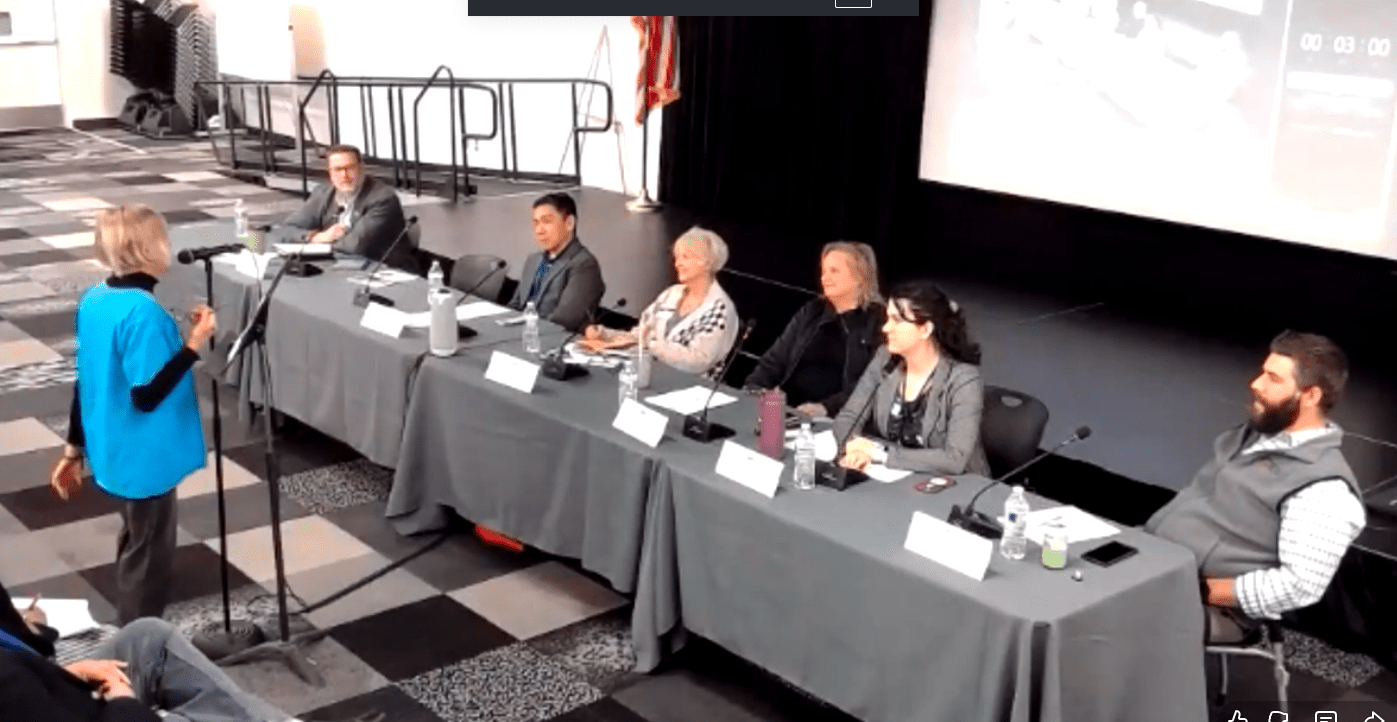
Nine Coalition members spoke at the Nov. 19, 2025, PPLD board meeting to explain their concerns and ask the board to delay a vote on CSURA’s proposed updated TIF agreement for the project until Norwood re-entered conversations with the Coalition to address the group’s concerns. At the time, talks had stalled.
Coalition leader Max Kronstadt told the board Norwood said it was not interested in a formal agreement, but was open to a partnership. He said Norwood asked the Coalition for a list of comprehensive goals which they presented to Norwood in September. According to Kronstadt, Norwood said it would review the goals and give feedback after a few weeks – but the Coalition did not hear back from Norwood.
Coalition member Catherine Duarte is the senior vice president of housing development at Catholic Charities of Central Colorado. She said when she worked at the City of Colorado Springs she was the project manager and co-author of the Mill Street Neighborhood Plan approved by governing bodies in 2019, and encouraged the board to read it to understand the neighborhood’s vision.
“We did and do not feel that a luxury hotel is an appropriate use of public financing in a neighborhood where the biggest concern is displacement and the most urgent need is affordable housing,” she said.
Several speakers said the goal was not to stop change or oppose development, but to make sure the neighborhood residents were not harmed by it.
“After decades of public disinvestment, Mill Street is now being gentrified by rapid reinvestment, featuring tax-payer supported soccer stadiums, upscale apartments, and luxury hotels,” said Coalition leader Mary Sprunger-Froese. “Some Mill Street neighbors have already been pushed out, primarily long-term renters who hoped to buy their homes one day, but couldn’t after their value nearly doubled in a few short years. Mill Street neighbors are disproportionately renters, elders, living with disabilities, or living below the poverty line, making us particularly vulnerable to displacement.”
Julie Smyth, president of the library board, said the board listened to the Coalition’s public comment.
“After hearing the Mill Street neighborhood’s concerns at the November board meeting, the Board asked for clarity from the Urban Renewal Authority prior to and during the December board meeting regarding whether those concerns were being addressed,” she said.
However, she pointed out, the board has legal obligations to consider when voting on URA proposals – voting “no” can get sticky.
“The PPLD Board has no authority over the details of URA proposals,” Smyth said in a statement to the Bulletin. “Under Colorado law, the local governing body of a municipality has primary authority over approval of URAs. Other government bodies, such as PPLD, which are asked to contribute part of their tax increments to the URA, do not have input into contract details. If such bodies vote down a URA proposal, under Colorado law they can be required to enter mediation to come to an agreement with the URA, a process that can include costly legal fees.”
TIF for housing
At its Dec. 9, 2025 meeting, the library board voted 4-1 to approve the URA TIF agreement – with the stipulation that the TIF be allocated only to the attainable housing phase of the project.
Smyth, Scott Taylor, Debbie English, and Erin Bents voted for; Aaron Salt voted against.
English, who made the motion to approve, said she hoped future URA rules would not allow taxpayer dollars to be used for luxury hotels.
At the time of this writing, Kronstadt said the talks between the Coalition and Norwood were scheduled to resume very soon.
Norwood and CSURA could not be reached for comment.