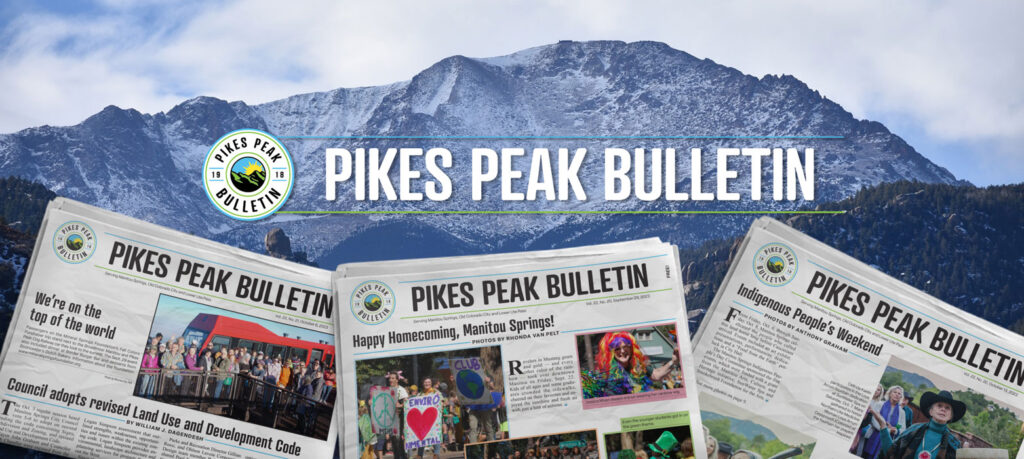
The Pikes Peak Bulletin has fought for its relevance in the digital age. Historically the hometown newspaper of Manitou Springs, the Bulletin, along with a collection of other newspapers, was re-homed under the umbrella of Sixty35 Media, a non-profit media organization serving the Pikes Peak region in 2022. Hopes that this would prove a financially viable media model were quickly extinguished in early 2023 when the organization folded.
By spring of 2023, local residents – led by Lyn Ettinger-Harwell – scrambled to keep the paper solvent.
“I was going to be the temporary publisher, you know, to try to get this thing off the ground. And it just kept going and going and going,” says Ettinger-Harwell.
Heila Ershadi, a former newspaper owner and city council member in Moab, Utah, joined the paper in the spring of 2024. From that fateful moment until February 2025, the paper’s circulation grew from approximately 1,800 copies a week to 6,600 in addition to a surge in online readership.
Yet in July 2025, the Bulletin paused print publication to “assess its financial concerns and the best path forward,” says Ettinger-Harwell.
The Bulletin brought on a slate of new board members, and a new publisher, and moved to a primarily digital model serving the region.
A NEWSPAPER REINCARNATES ITSELF
What sets this community news outlet apart from others is its ability to rise like a phoenix, seizing multiple opportunities to reinvent itself. Juaquin Mobley, a serial social entrepreneur whose work spans fashion design, education, and community health, has built a reputation much like Ettinger-Harwell’s as a Renaissance man. As Executive Director of Community Anchor Academy, owner of WHealthy Juice Bar, and program strategist for Motus Theater, Mobley now finds himself reflecting as the new publisher and what it means to reinvent the Bulletin.
Mobley’s passion for writing started in high school when he wrote for his school paper and won poetry competitions. Most recently, he partnered with Brink Literacy to create a comic book about his experience rebuilding his life after incarceration. But, Mobley emphasizes his strengths lie on the business side.
“I remember we were all having lunch – me, Heila, and Kevin [Mitchell, now a board member] – and all these ideas just started firing,” he says about that serendipitous conversation. “I’m shooting them out, and she’s like, ‘Man, I like that.’”

After a subsequent meeting with Ettinger-Harwell, he received an unexpected phone call and the question, “Hey, do you think you would want to be a publisher?” Mobley laughs at the memory. After a discussion about what being publisher would entail, Mobley decided it was the right move.
“I don’t know if it was just an opportunity, or if it was meant to be – as corny as that sounds,” he said.
Mobley’s vision for the Bulletin’s future is both ambitious and practical, drawing on groundswell strategies that rethink how the Bulletin connects with its audience digitally. He brings the perspective of a CEO with instincts of an entrepreneur, with the advantage of deep community roots. His plan is to meet people where they are – on the street, in local businesses, and online – by blending information and entertainment in ways that invite participation, what he refers to as “edutainment.”
The print edition will shift to a quarterly schedule, but with a new identity: magazine-style layouts and, as the Bulletin builds capacity, creative flourishes such as art posters meant to be pulled out and displayed at home.
Central to this expansion is inclusion. The Bulletin’s coverage will expand beyond Manitou Springs, the Westside, and downtown Colorado Springs and into Hillside, Knob Hill, and southeast COS, shedding light on hyperlocal stories that often go untold.
Mobley is already building partnerships with schools like Community Prep, where students will gain media literacy by writing restaurant reviews and covering sports stories, giving young people a stake in telling their own community’s story. [Editor’s note: Mobley is a Community Prep School board member.]
Building financial sustainability is at the forefront of Mobley’s focus. His approach will be to cultivate partnerships with chambers of commerce, school districts, and other organizations while expanding the Bulletin’s presence across TikTok, podcasts, and social media. But it’s not just about reach; it’s about accountability. He plans to utilize investigative journalism to monitor issues such as judicial decisions and municipal spending, and present information in an accessible way.
THE BULLETIN’S A-TEAM
Joining Mobley in this transformation is newly elected board chair Warren Epstein, a 40-year veteran of journalism who brings both experience and urgency to the role. A longtime Manitou resident, Epstein’s connection to the Bulletin runs deep – from seeing his children’s names in the paper for their soccer achievements to recognizing it as an essential voice in the community.
When Ettinger-Harwell noticed Epstein’s political commentary on Facebook and invited him to contribute, a new relationship with the paper was born. Now he’s launching “The Epstein Files,” a column that will tackle hidden stories and connect national issues to local realities. A recent piece asks why Colorado Springs residents should care about Washington politics, then answers with a stark example: “Take a look at when Black Forest is becoming wild, wild west with ICE shooting at cars. This is changing the landscape of where we live.”
Managing Editor Heila Ershadi brings hard-won experience to the Bulletin’s newsroom, having owned and operated the Moab Sun News through some of journalism’s most challenging years, including the pandemic that shuttered newspapers across the country. Her path to journalism was unconventional – starting in Moab, Utah, with a successful city council run that grew from her frustration with issues going unaddressed, then pitching stories, writing them herself, and eventually buying the paper when the newspaper’s founder asked if she was interested. After selling the newspaper to her editor and moving to Colorado Springs to care for a family member, she worked at a local nonprofit serving children before realizing journalism is her “true love” and a “calling.”
Now at the helm of the Bulletin’s editorial operations, Ershadi is committed to both rigorous reporting and humanizing storytelling. Her approach is guided by a medical principle: “first, do no harm.” As the daughter of two immigrants – her father came from Iran in the 1970s and experienced discrimination – she understands the power of language and representation in the media.
“It is such a high-stakes political, social, and historical moment,” she reflects. “I do not think it has ever been more important to offer people the opportunity to see their neighbors as humans and to understand why each of us, everyone of us, has a life and has rights worth protecting.”
This philosophy drives her editorial vision: turning down the temperature in polarized times by presenting facts and people as they are, not through narratives that create “good guys and bad guys, us vs. them,” she states.
““It is such a high-stakes political, social, and historical moment.”” – Heila Ershadi
Recent coverage of an ICE arrest in Colorado Springs exemplifies this approach. She contacted ICE and local law enforcement, verified facts, and critically examined the dehumanizing language in ICE’s official statement, providing coverage that she notes other outlets did not.
“The Bulletin has a role … of keeping us to our better selves,” she says.
Board member Shaun Walls understands intimately what happens when communities don’t control their own narratives. A retired Army veteran who has been deeply embedded in southeast Colorado Springs organizing since De’Von Bailey’s death in 2019, Walls helped build what he calls “the infrastructure that it takes to amplify our voices” through his work with the Chinook Center and as part of the founding members of Men of Influence (MOI). He sees the Bulletin as the missing piece – the connectivity that can channel those voices into lasting impact.
“History is from the pen of the victor,” Walls explains, describing how outside narratives have long defined southeast communities. “They conquered this … they’re telling our story for us.”
But, Walls notes, when community members tell their own stories, something different emerges.
“Our story is gonna create positivity … and the residual from it is gonna create momentum,” he says.
He frames inadequate coverage of systemic inequities – such as medical outcomes and educational disparities – not as mere oversight but as harm.
“We don’t look at it as violence against us when the hospital’s different mortality rate is what it is … or the school district,” he says. “That’s violence … they are trying to kill us, not just the police pulling their gun out.”
The Bulletin’s legitimacy as an established publication, combined with diverse leadership changes, alters the equation.
“With it already being established … it checks all the blocks,” Walls says. “And it’s talking about me. It’s talking about us.”
That’s the difference between being covered and being seen, between being a subject and being heard, he says.
LETTING GO, LETTING GROW
For Ettinger-Harwell, stepping back from the publisher role he held as a volunteer – often working 60 to 90 hours a week – isn’t an ending but an evolution. After shepherding the Bulletin from near-death to viability, he’s energized by what comes next. He points to innovative models, such as Detroit’s Outlier Media, which delivers news via text message to residents who may not have access to computers, and the Colorado Sun’s success as a digital-first publication.
“Digital would always be the way to go into the future,” he reflects. “Print, there’s a place for print, and I love having a newspaper that you can open and read … but the future of media is digital.”
The expansion beyond Manitou Springs, he admits, requires letting go.
“Manitou will still have its voice. It’s still the home, it’s still the tradition of the Bulletin. But … we’re doing some different stuff,” he says. “It’s like life sometimes, and life in love; you’ve got to let it go. Let it go and let it grow.”
His pride in the paper’s transformation is evident.
“Looking at the diversity of what the publication can become or is becoming, is just mind-blowing, really mind-blowing,” he marvels.
Mobley says he sees the Bulletin becoming in the next year “a strong force of information throughout the city, specifically in the areas of expansion.” In five years, he envisions a complete set of media offerings including podcasts and video “with the ultimate goal of establishing a centrally located facility that serves as a true multimedia hub for the region.”
But beyond platforms and reach, Mobley returns to impact. In addition to viewership numbers, success will be measured by “the impact that we make with the nonprofits, small businesses, and … civic engagement,” he explains. He encourages nonprofits, chambers, and residents to make the Bulletin their first call for coverage, to contribute stories and to engage.
After 107 years of publishing, the Pikes Peak Bulletin is doing what few legacy papers manage: reinventing itself not by abandoning its roots, but by deepening them – expanding who gets to tell the story, who gets heard, and who gets to shape the community’s future. In an era of desolate news coverage and media consolidation, that might be the most radical act of all.