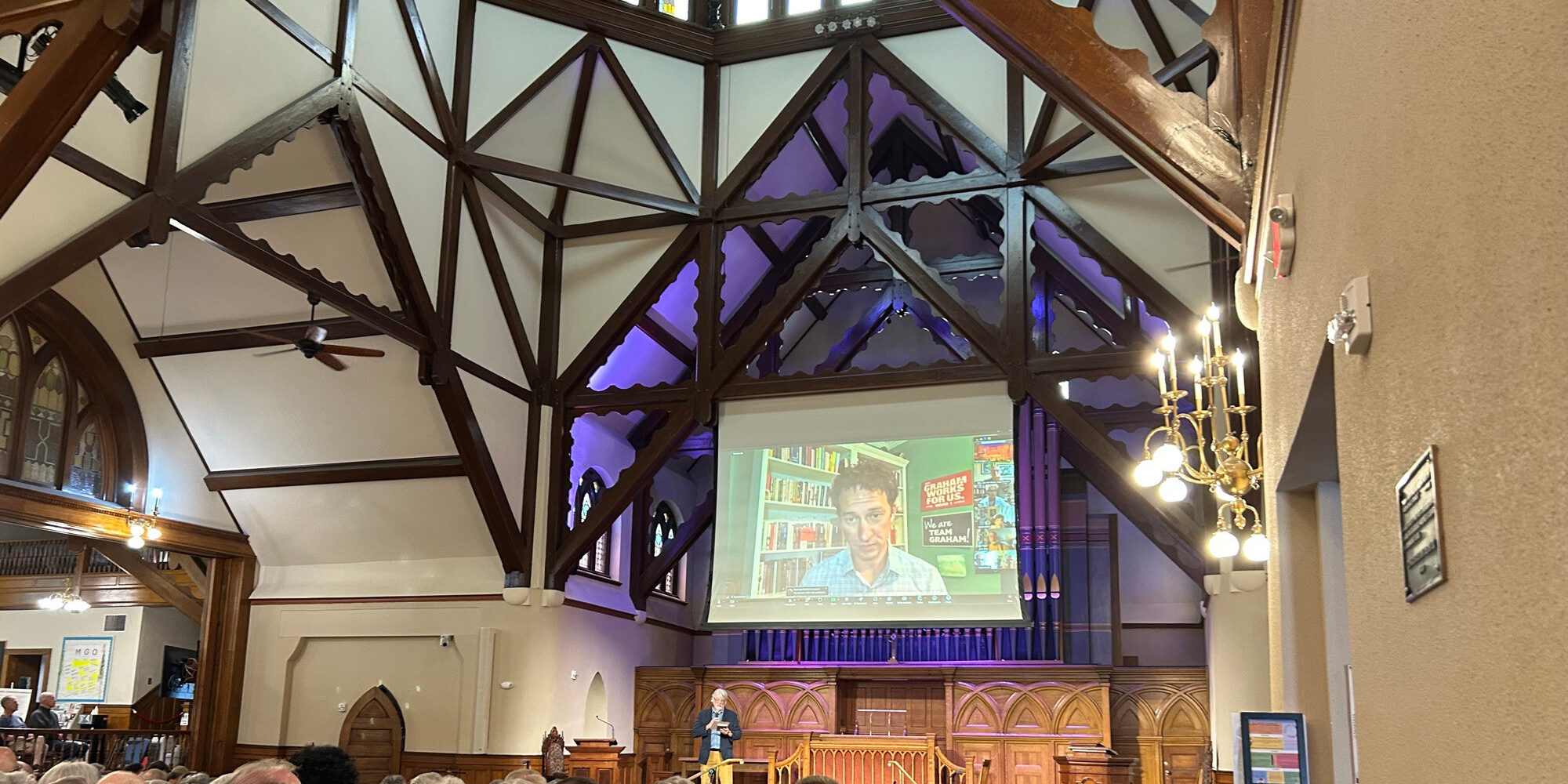
The University of Colorado at Colorado Springs’ Center for the Study of Evangelicalism concluded its four-part series on The Heritage Foundation’s Project 2025 at First Congregational Church with a presentation from David A. Graham, staff writer at The Atlantic magazine and author of “The Project: How Project 2025 is Reshaping America.”
Project 2025 is a 900-plus page right-wing gameplan to reshape the culture of the United States and the federal government.
“What’s probably good news for my publisher – bad news for the country – Project 2025 remains extremely relevant now, and I expect it will continue to be so for the foreseeable future,” said Graham via Zoom to the packed audience inside the church. “We’ve seen Congress pass these in the One Big Beautiful Bill Act, which, looking through it, [you] see the fingerprints of Project 2025 in many places: Immigration enforcement, increased military spending, tax cuts, reductions to Medicare, Medicaid, reductions to SNAP, food assistance. These are all priorities that come from Project 2025.”
Graham noted the influence of evangelical Christianity on the growing Christian Nationalist movement. Christian Nationalism is an ideology that views America as fundamentally Christian and believes the government should operate as such.
While “evangelical” has generally referred to the worldwide, interdenominational movement within Protestant Christianity that emphasizes evangelism, or the preaching and spreading of the Christian gospel, in recent years it has become a broad label for a large swath of conservative, often nondenominational, Christian churches and ministries, many of which have explicitly embraced partisan politics. Many contemporary evangelical churches split off from mainstream denominations over issues such as women’s ordination and the affirmation of LGBTQ people.
“One of the things that I think is most interesting in polling and surveys about religious life in America is the extent to which evangelicalism has come to be more a cultural identity than necessarily a religious one,” he said. “You have many people identified as evangelical Christians who don’t regularly attend services. They’re basically Christmas and Easter people, but they still call themselves evangelical.”
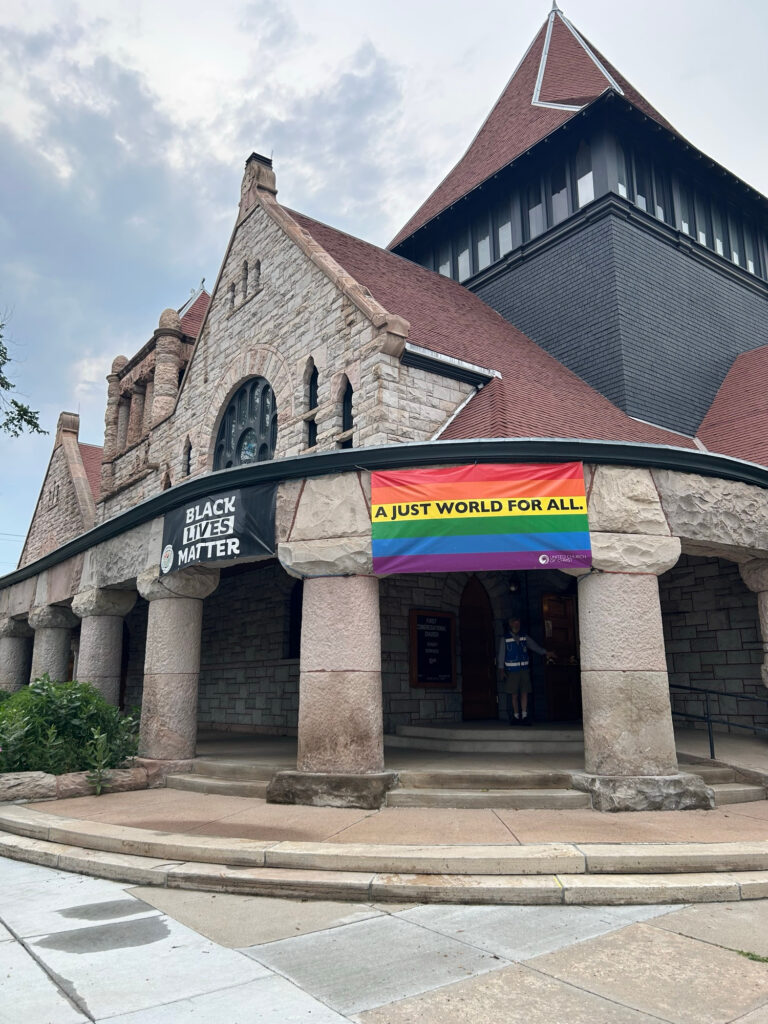
“I think that the mixing of politics and church often leads people to bad theology,” said Graham to an audience inside a church prominently displaying Black Lives Matter and Pride flags. “It mixes the secular and the holy in ways that Jesus himself warns against.”
Current events spur scholarly study
The current political concern about the rising influence of evangelicalism has led to prominent scholars, like Kristen du Mez, historian and author of “Jesus and John Wayne,” receiving more attention on their work.
“We got a big grant about a year and a half ago from the [Henry] Luce Foundation and a good chunk of that money was earmarked for starting this Center for the Study of Evangelicalism,” said Jeffrey Scholes, director of the Center for the Study of Evangelicalism. “There is no center for the study of evangelicalism anywhere in the country. There was one, but it’s been defunct for about 12 years now. We’re in Colorado Springs, and we’re at a state university, and so we knew that there can be a trust on how we’re going to handle evangelicalism at a state university. There’s a lot of scholarship out there … We have four scholars coming in in the fall. We had nine events last year. So there’s just a lot of interest in the community and a lot of scholars working on evangelicalism in all its … shapes and sizes, how it stretches into politics and the culture, English literature, whatever it may be. We’re bringing in a lot of different scholars and community members to talk about evangelicalism, in the fullest possible sense.”
Scholes said the Project 2025 series was a successful event for the Center.
“[We’ve] been incredibly pleased with the turnout,” he said. “The first two events, there were people turned away [at the door due to space limitations] and we had an online presence here. So probably – I don’t know – 400, 500 people that were in attendance. So it was great.”
He said the question and answer sessions were “excellent” and gave “more of a sense of what the people are thinking and what the problems are.”
Scholes added, “You never know with these kinds of events whether anything can happen, but if we don’t meet like this, I can guarantee you that nothing will.”
For more information, see the Pikes Peak Bulletin’s July 17 article “Project 2025: How the right-wing playbook is reshaping the US.”
Please consider making a donation to our nonprofit newsroom.
Sign up for our free weekly newsletter!