U.S. Vice President JD Vance rose to national prominence with his memoir “Hillbilly Elegy” and the book’s film adaptation in which Vance’s personal experience of the opioid epidemic figured heavily.
In 2016, he wrote in The Atlantic Magazine, “Shortly before I graduated from law school, I learned that my own mother lay comatose in a hospital, the consequence of an apparent heroin overdose. Yet heroin was only her latest drug of choice. Prescription opioids – ‘hillbilly heroin’ some call it, to highlight its special appeal among white working-class folks like us – had already landed Mom in the hospital and cost our family dearly in the decade before her first taste of actual heroin.”
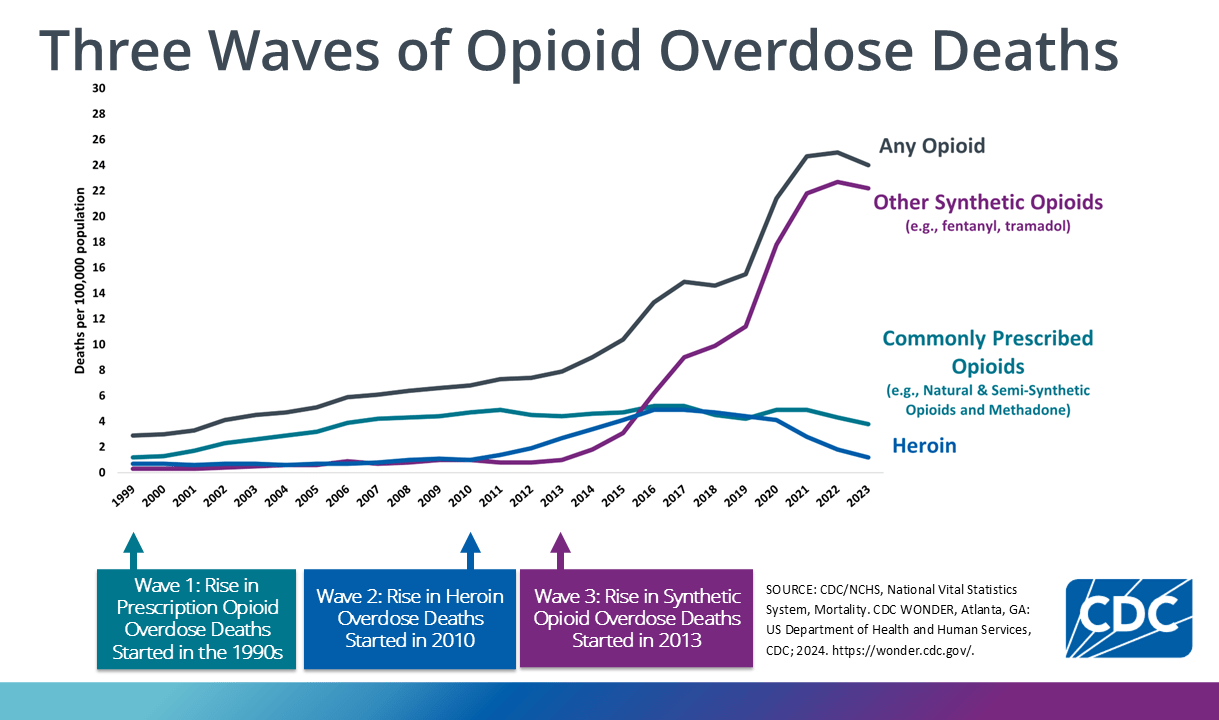
Vance’s experience encapsulates national trends in the opioid epidemic identified by the Centers for Disease Control and Prevention (CDC). The CDC splits the opioid epidemic into three waves: Wave One started in the 1990s when drug companies began aggressively marketing opioids such as oxycodone, telling medical professionals patients would not become addicted – but the rise in prescriptions led to a surge in use and addiction. Wave Two broke in the early 2010s as efforts to reduce opioid overprescription led many people with dependencies to turn to street opioids like heroin – and sent heroin-related overdose deaths soaring. Wave Three started in around 2013 and continues today with fentanyl and fentanyl-like compounds involved in most opioid overdoses.
Nationally, about 806,000 people died from an opioid overdose between 1999 and 2023, according to the CDC, including 105,000 in 2023. El Paso County data from 2023 – the most recent year for which data is available – counts 119 overdose deaths as having involved fentanyl.
The good news: New provisional data from the CDC indicate a nearly 24% decline in drug overdose deaths in the United States for the 12 months ending in September 2024 compared to the previous year. “This is the most recent national data available and shows a continued steep decline in overdose deaths,” the CDC website states. “Provisional data shows about 87,000 drug overdose deaths from October 2023 to September 2024, down from around 114,000 the previous year. This is the fewest overdose deaths in any 12-month period since June 2020.”
That decline comes as national settlements fund a variety of programs across the nation to combat the opioid crisis at the local level.
Local solutions to a national problem
Over a dozen Pikes Peak-area agencies have or are about to receive funds to combat the opioid epidemic close to home via the Region 16 Opioid Council’s grant funding program.
The Council’s website, PikesPeakRegion16.com, explains the grant funds are part of national settlements reached in 2020-2021 with Johnson & Johnson and the nation’s three largest drug distribution companies to resolve claims by state and local governments that these companies contributed to the opioid epidemic. Colorado is set to receive more than $700 million when the settlements are finalized and distributed in a formula spelled out in the Colorado Opioids Summary Memorandum of Understanding: 10% directly to the State; 20% directly to participating local governments; 10% to specific abatement infrastructure projects; and 60% directly to Regions. El Paso and Teller Counties “opted-out” of the direct 20%, directing it to control of the Region 16 Opioid Abatement Council. Voting members of the Council include Fourth Judicial District Attorney Michael Allen and officials from the City of Colorado Springs, El Paso County, Teller County, and Fountain and Monument police departments. The Council has nonvoting members and community members composed mainly of medical and public health professionals and others who work with affected populations or have firsthand experience of the opioid crisis.
A spokesperson for the Council explained grant totals will vary year-to-year, saying, “Annual funding amounts are not available. The Council continues to review as lawsuits are settled and funding comes in.”
According to the Council’s website, the next funding application cycle will start in October.
Funded agencies
One of the larger grants awarded – $581,340 – went to Homeward Pikes Peak, a Colorado Springs nonprofit providing housing with supportive services, a substance use clinic and street outreach.
Chief Executive Officer Beth Roalstad told the Bulletin, “Homeward Pikes Peak is very pleased to be a grant recipient of the Regional Opioid Abatement Council for a second year. This contract and award allows HPP to deliver five separate programs that provide a continuum of services from street outreach, clinical services and sober living housing that addresses the problem of addictions in our community. We are committed to effective treatment options and meeting clients where they are to engage them into an array of services. We are unique in this community for this strong constellation of services that help move people who are motivated to change their lives and enter long-term recovery.”
Colorado Springs City Council Member-at-large David Leinweber said he was especially glad to see support go to Homeward Pikes Peak.
“Housing creates stability, and stability opens the door to recovery,” Leinweber told the Bulletin. “When someone has a safe place to live, they’re more likely to engage in treatment, reconnect with family, and rebuild their life. It’s a program that doesn’t just respond to crisis – it helps people imagine a future.”
CASA of the Pikes Peak Region received a $50,000 grant. CASAPPR trains local volunteers who may then be appointed by a judge to advocate for the best interests of children in the foster care system.
CASA Executive Director Angela Rose told the Bulletin, “Sixty four percent of the families we serve have been impacted by substance abuse and opioids are often one of these substances. The funds CASA received will be used to serve the children who are severely traumatized by addiction through no fault of their own. CASA will give these children a voice and advocate to get them to a place where they are safe and free from the abuse and neglect that is so often present in families suffering from addiction.”
Megan Colwell, CEO of Face It TOGETHER which received $88,500, told the Bulletin her organization would use the funds to provide “compassionate, professional peer coaching throughout El Paso and Teller counties.”
“Through the power of the peer, we’ll help individuals impacted by opioids, including loved ones, on their paths to wellness,” she said.
The Transition Assistance Program (TAP) run by the City of Colorado Springs and the Colorado Springs Fire Department received $300,000. Fire department spokesperson Ashely Franco told the Bulletin, “Our Transition Assistance Program has worked tirelessly to build impactful relationships with a vulnerable population to help them rebuild their lives in a positive manner. The TAP team provides resources for shelters, mental health, substance abuse, among other things with a goal to reduce the number of those experiencing homelessness in the court system and our jails. This program has proved successful for our community and we are grateful we get the opportunity to continue to provide this service.”
Other agencies funded so far this year include Full Circle’s youth peer-led recovery ($213,500); TESSA’s youth empowerment and advocacy program ($180,126.91); One Chance to Grow Up’s youth prevention and education program ($194,000.00); Crossroads Turning Point’s Medication Assisted Treatment ($242,550); Community Partnerships Family Resource Center ($167,000); Serenity Recovery Connection Recovery Community Organization ($408,466.19); and Hope COS ($356,197.14) for recovery supports and transitions.
The total approved so far in 2025 is $2,781,680.
Leinweber said there were several start-up organizations who weren’t funded this time – but he hopes they fine tune their proposals and try again next time around, saying, “their passion is needed.”
He spoke to the need for a holistic community response to the public health emergency around opioids.
“The opioid crisis doesn’t start with opioids – it starts with hopelessness, isolation, and loneliness. If we want lasting change, we have to look upstream,” he said. “Government and local agencies must work together on diversion programs, prevention, and community support that give people hope before they ever reach for drugs.”
[Editor’s note 9-23: This story was update with total 2025 grant amount information provided by the County.]