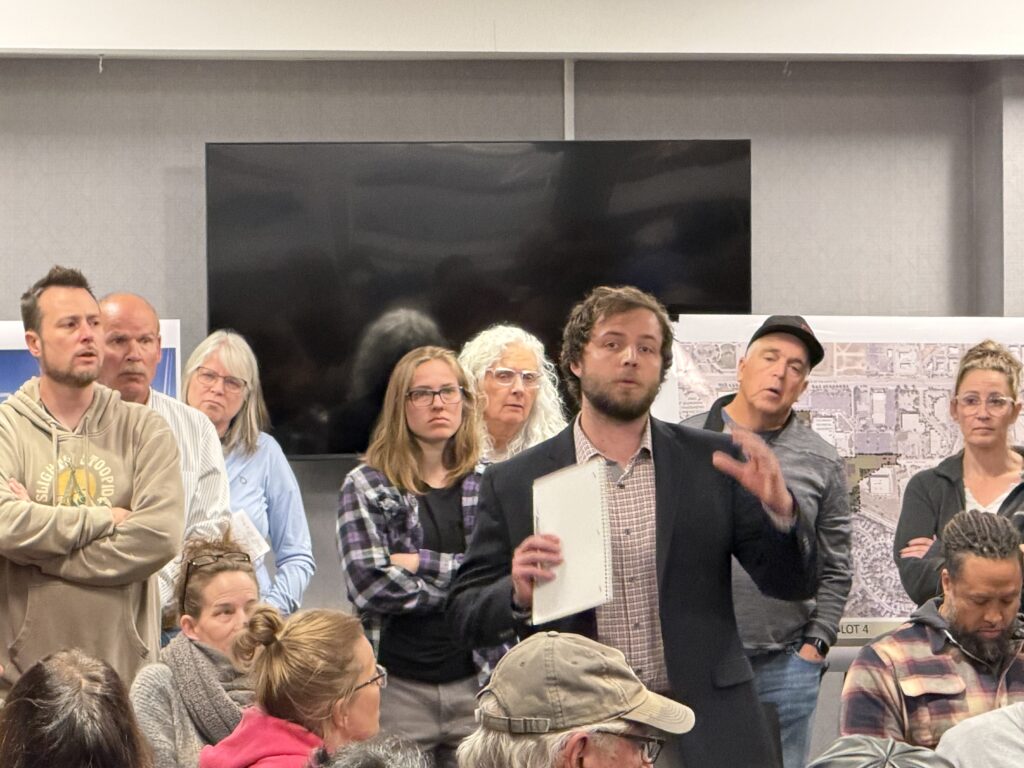
Jason Green, the co-founder and COO of Raeden, fielded questions from often irate residents during a presentation Tuesday evening on a proposed data center near Garden of the Gods Road and Centennial Boulevard. The location is adjacent to the Chelsea Glen neighborhood, and residents packed a conference room in the Hyatt Place near the would-be data center site to question Green and express frustration at the latest plans for the property.
“[The building] was built as Rockwell way back and it didn’t realize its potential back then,” explained longtime resident Eileen Armstrong, whose home is 300 feet from the proposed data center. “Rockwell laid idle until the city attracted Intel, and then Intel spent a year developing it and making it what they wanted – at great noise to the community – but even Intel was a better neighbor than what has come since. Intel operated for about three years there, and that bubble burst and they were off to India to build their chips, and the city was left with another big behemoth that lay idle until they attracted Bitcoin. And then Mr. [John] Chen came in with his Bitcoin venture operation – those promises sound a lot like this meeting – and they installed everything and it was a nightmare. The wildlife left, birds left, and we were left with carrion birds and magpies. There were no birds singing in the morning. You didn’t open your windows because … the drone was always there.”
Green attempted to allay concerns about noise pollution. “The differentiation between a Bitcoin operation and an AI data center is dramatic,” he said. “They’re wildly different operations. I’m not telling you one is good or bad versus another. I’m just telling you that they’re very different. Noise creates vibration. Vibration – for the types of computers that are installed in the data center that we’re contemplating – is incredibly problematic. Meaning that any level of vibration disrupts the performance of those devices in those computers and we are required to tamp that down. This is one of the reasons why we like the building, because in a chip [fabrication] you know what you can’t have? Vibration. So the building itself is built in a very specific way.”
Residents also raised concerns about water and energy consumption. Data centers can require large amounts of electricity to power their computers, and large amounts of water to cool them. Last week, Xcel Energy, the power utility for Denver, Boulder, and other Colorado municipalities, released a proposal to charge data centers and other huge commercial customers for the full costs of powering their operations, in a bid to prevent residential customers from footing the bill for the AI boom. In February, Denver announced a moratorium on new data center construction in the city to allow Denver City Council to consider appropriate regulations around the growing industry.
Jared Miller with Colorado Springs Utilities explained to residents that Green’s power costs would not be passed on to residential consumers. “All large load customers go through what we call the electric large load rate,” he said. “The electric large rate basically, as Mr. Green has talked about, has cost for his power paid by him. So his power costs and the generation necessary for his facility are paid by Mr. Green or any other large load rate [customer]. It’s a tariff rate.”
Green claimed that water use, after an initial 200,000 gallons (roughly the amount used by two households in a year), would be minimal due to a more efficient closed-loop cooling system. “Historically data centers, up until about 2015 to 2018, used what’s called evaporative cooling,” he explained. “The water would evaporate to create a cooling medium and then you got to replace the water. We learned over time from industrial manufacturing – there is almost nothing in the data center that is new. We borrow from others. Industrial manufacturing has been using closed-loop cooling systems for a long time, which means there’s no interaction of that water with the air. If there’s no interaction, there isn’t any removal of water. We’re not evaporating.”
Despite Green’s assurances, residents remained unconvinced. Austin Cooper with the Colorado Springs Planning Department explained the approval process for the facility. “The use is permitted within the zone district that this building is a part of,” he explained. “So it’s an administrative review, which means that if they address all of the city’s comments, both technical and otherwise, it would get approved.”
Residents unhappy with that potential approval can appeal. “There is an appeal process for the approval to the City Planning Commission,” said Cooper. “You can appeal that to City Planning Commission. If they disagree or agree with your appeal, you can then appeal it to City Council as the ultimate decision maker, so there’s a long process left.”
Potential state incentives, regulations
The Colorado legislature is currently considering two competing measures to address data centers. House Bill 1030 will offer sales and use tax exemptions for data center builders, while Senate Bill 102 attempts to provide accountability for the industry’s water and electricity consumption. Green said their project would not be eligible for any potential future tax incentives, but would have to participate in the requirements of Senate Bill 102.
“If it does pass, we then partner with the utility to go and procure green energy resources that we would then be using,” said Green. “It’s a payment program that we have to be a part of.”
Green was also unable to identify what company would be utilizing the proposed data center. “Raeden builds and operates the data centers, which means that we are essentially facilities engineers,” he said. “We make the power, we make the cooling, we make space, the security. We’re infrastructure people. Our customers are the ones that come in and install the computers … I can’t tell you names. Those are NDA [non-disclosure agreement] protected, that’s up to them.”
Due to the capacity crowd at this week’s meeting, Colorado Springs Media Relations Manager Max D’Onofrio said there would be additional meetings coming soon. “The developer will plan another meeting,” he said. “We don’t know when that’s going to be.”