Nico Wilkinson (they/he) woke up on Nov. 20, 2022, to a flurry of confusion. Text messages flooded their phone screen, asking if they were okay. Frantically written Facebook posts inquired about the whereabouts of friends who weren’t picking up the phone. Half-asleep, Wilkinson tried to figure out what had happened. Then, they saw the headlines about a mass shooting that had occurred at a Colorado Springs nightclub overnight.
It was Transgender Day of Remembrance, and Wilkinson had agreed to speak on behalf of Inside Out Youth Services at Vista Grande Community Church. Unsure of what else to do, they drove to the church and spoke.
“I’d been to Club Q, and I knew Daniel [Davis Aston]. He used to come get haircuts at my house,” Wilkinson recalled. “As I was sitting in the pews after I spoke, I found out that Daniel had died.”
In a desperate attempt to externalize the grief and rage they felt, Wilkinson jotted down a poem on their phone, screenshotted it and posted it to Instagram. It was titled “trans day of i love you.”
“I found myself feeling like we deserve a better holiday than this. We deserve a better day than this one,” Wilkinson said. “Why do we get remembrance? Why do we get visibility when the visibility isn’t even safe?”
Wilkinson’s Instagram post now has over 35,000 likes. Every Transgender Day of Visibility or Remembrance, it takes off again. While they are incredibly grateful that their poem could make so many people feel empowered, Wilkinson can’t help but feel haunted by “trans day of i love you” – a manifestation of their grief that’s become completely divorced from the time and place it was written in.
More often than not, a poem is a vessel. In writing it, the poet confronts and seals away some part of themself – an emotion, a memory, a relationship.
That’s how Wilkinson became a poet in the first place. In middle school, just after their grandmother died, Wilkinson wrote a poem about how, while the spring showers would resurrect the plants and flowers, their grandmother would remain buried.
Wilkinson began filling countless notebooks with poetry. As they went to their first poetry slams at Mercury Cafe and studied under mentors like Idris Goodwin and Jane Hilberry at Colorado College, they fell even more deeply in love with the medium.
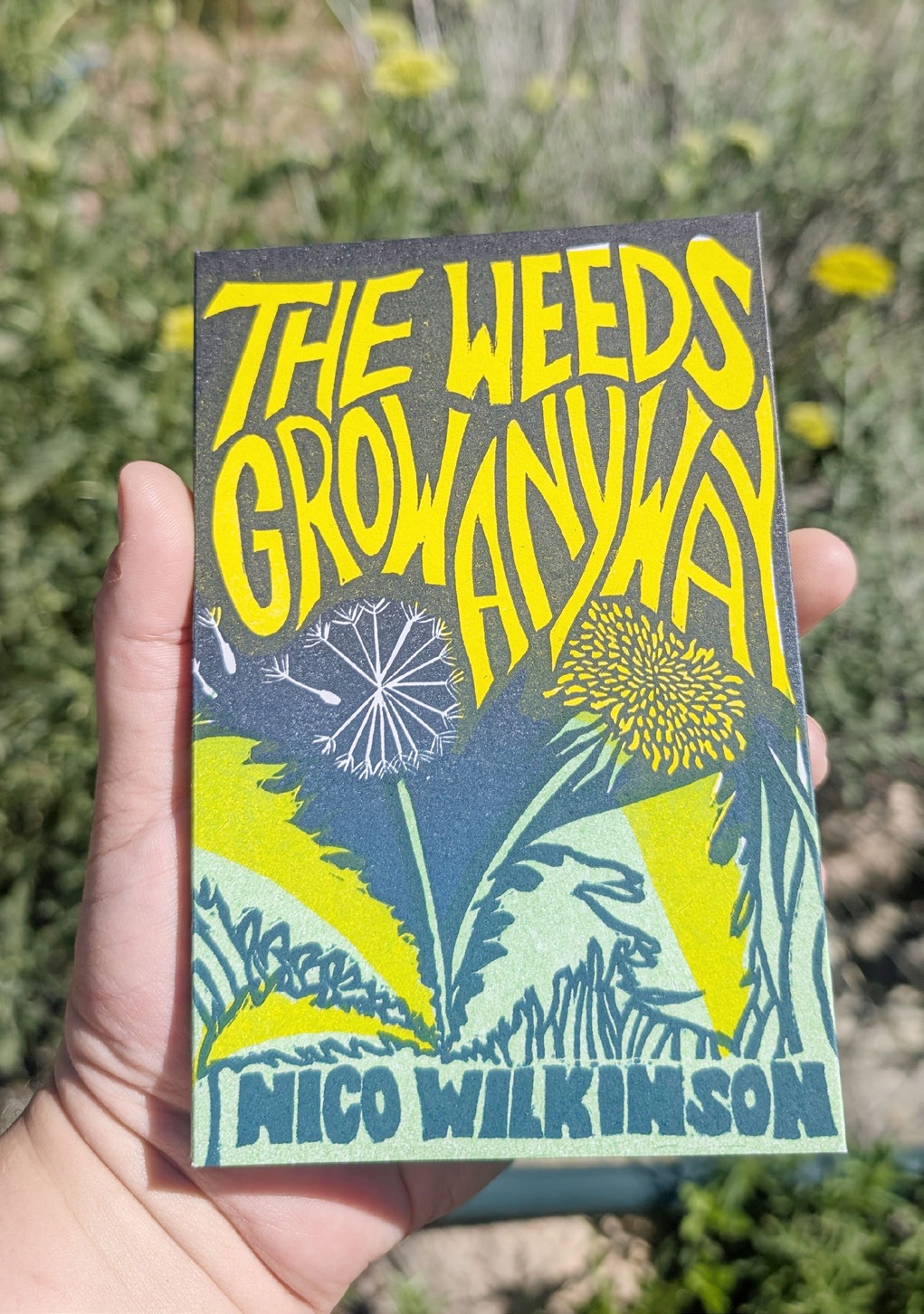
Wilkinson’s passion culminates in their first full-length poetry collection, “The Weeds Grow Anyway.”
Written between 2016 and 2025, the collection is a time capsule of Wilkinson’s twenties. It’s a book covered in fingerprints of Wilkinson’s identity, memories and relationships.
Many of the poems are influenced by Wilkinson’s unique living situation. In 2017, they bought their first home and founded a commune for queer artists, complete with goats and chickens.
“I think I lived with almost 20 people in those seven years. But I learned from everyone I lived with. I learned from the animals that I spent time with. I learned from everyone that I dated in that time,” Wilkinson recalled. “The lessons vary, but it’s all still important.”
Wilkinson began phasing out the commune a few years ago for several reasons, including lingering effects of Long COVID, which caused them to lead a more introverted lifestyle, and the emotional exhaustion involved in raising chickens. One poem in “The Weeds Grow Anyway” references Wilkinson’s grief as he woke up to realize a predator had broken into the coop.
Nature is an overarching theme of the anthology as Wilkinson finds the gentle beauty in everything from worms in a compost bin to the supercontinent Pangaea, whose shifting continents are likened to a fading relationship.
The book’s signature lowercase writing style was developed when Wilkinson studied in Minneapolis during their senior year of college. Transporting a typewriter in a milk crate attached to their bicycle, they busked around the city, writing poems for passers-by. The typewriter had a broken shift key, so Wilkinson could only write in lowercase.
While they were in Minneapolis, Wilkinson became immersed in the city’s queer poetry community through open mics. It was unlike anything they’d experienced in Colorado Springs.
When Wilkinson returned to Colorado Springs, they were often advised at open mics to shy away from queer topics to avoid offending the audience. At one open mic, an audience member snatched the mic from them while they were onstage. It was clear that a safe space was needed for LGBTQ+ poets. With Han Sayles, Wilkinson founded the Keep Colorado Springs Queer open mic in 2016.
That year, Wilkinson graduated from Colorado College and was invited by former professor Idris Goodwin to co-write a poetry collection called “Inauguration,” inspired by the election of Donald Trump. The Fine Arts Center was packed for the book launch event on Jan. 20, 2017, and the books quickly sold out, demonstrating to Wilkinson what he could accomplish in self-publishing.
We are a natural part of this world. – Nico Wilkinson
In 2018, Wilkinson co-founded Prickly Pear Printing, an independent press which published several poetry anthologies exploring LGBTQ+ love, joy and growth.
Wilkinson’s obsession with bookbinding is evident in the odes to letterpresses that crop up throughout their body of work.
“The nature of the art is built into the product, because sometimes, you get the indentation of the type on the other side,” Wilkinson mused. “When I’m in the studio printing and carving, I’m not worried about AI, because as it stands right now, AI can’t carve a piece of linoleum.”
The cover of “The Weeds Grow Anyway,” which was printed using a combination of risograph and linocut, features a dandelion, its seeds blowing off into the wind.
The book’s title and cover are inspired by one of Wilkinson’s poems, which begins with a quote from Colorado Springs Code Enforcement: “If it can grow without human intervention, it’s a weed.” Wilkinson champions both the weeds that grow in our gardens and the metaphorical “weeds” deemed unacceptable by society.
“I want queer people to know that there is a joy that people are trying to take from us, but it is our birthright, just as much as anyone’s, to have that access to joy and beauty,” said Wilkinson. “If you don’t give us water, we’re going to grow anyway. If you try to cut us back, we’re going to grow anyway. We are part of this ecosystem. We are a natural part of this world.”
“The Weeds Grow Anyway” releases on June 27. A launch event will take place at the Ent Center for the Arts, 6:30-8 p.m. The collection is available to preorder now at NicoWilkinson.com.