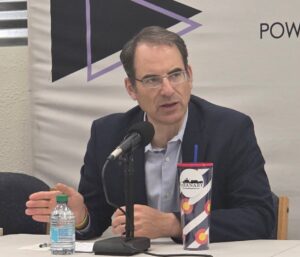
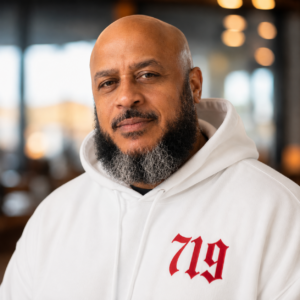
On Sunday, June 14, the Pikes Peak Bulletin and Community Anchor Academy hosted a gubernatorial Southside Candidate Forum. Moderated by Kimberly Gold, the Colorado Springs City Councilor for District 4 representing Southeast Colorado Springs, the forum was an opportunity to get to know candidates for governor in this year’s election and talk about issues from a Southside perspective. El Paso County Clerk and Recorder Steve Schleiker spoke on election integrity and the importance of voter turnout. About 50 people attended.
All of the candidates for governor whose names are on a ballot in the ongoing primary election were invited. Three accepted the invitation: Democratic candidate (and current Colorado attorney general) Phil Weiser and Unity Party candidates Paul Noel Fiorino and Jeff Peckman.
Studio 809 recorded the event which may be watched in full here.
“I’m here because I care about this community, and I want to hear from you – and I want to start by outlining what you can expect from me as governor, because it’s what you saw from me as attorney general,” Weiser said. “My commitment is to show up for all communities to listen to you, and then work together to get results.”

Weiser gave examples of how he has worked collaboratively in the past to address issues. He said he worked with Patience Kabwasa, director of the local food advocacy nonprofit Food To Power, when a proposed merger between Kroger and Albertsons grocery chains raised food access concerns for the Southside. They held a well-attended town hall meeting in Colorado Springs, one of a number of town halls around the state, that led Weiser to sue to stop the merger. (The merger was abandoned after several courts ruled against it.)
Weiser said he’s also held town halls in Colorado Springs “after law enforcement officers didn’t act the way we’d like them to act,” and helped create a database to track officers fired for cause.
“If a law enforcement officer violates your trust, is untrustworthy, or commits crimes, we have a system now to decertify those law enforcement officers,” he said, noting there is more work to do in improving law enforcement training, officer diversity, and increasing access to mental/behavioral health services “so that we’re not taking situations that should be dealt with by social workers and escalating them, and calling somebody a criminal.”
Weiser also said he wants to improve outcomes for formerly incarcerated persons in the state. He said Colorado’s recidivism rate – the percentage of formerly incarcerated individuals who are rearrested, reconvicted, or reincarcerated for a new offense within three years of release – is about eight percentage points higher than the national average of roughly 37%. (Editor’s note: The Bulletin reached out to Weiser’s team after the forum for a source on this statistic and was directed to Weiser’s Colorado Blueprint, which links to a 2024 Rocky Mountain PBS article with that statement in it. The Colorado Department of Corrections breaks down data by release year and may be found here.)
The prosecution of Tina Peters – the former Mesa County clerk convicted on multiple charges related to tampering with voting machines – was another example Weiser gave of his collaborative problem-solving skills. He said he worked with the Mesa County District Attorney Dan Rubenstein, who is a Republican as is Peters. Weiser said he and Rubenstein agreed Rubenstein should prosecute the case against Peters to show “it’s not about politics; it’s about the rule of law.”
He noted he’s worked at the state level in conjunction with local governments on solutions to the opioid crisis. He said Colorado has reduced overdose deaths from opioids by 20% in the last two years. (Editor’s note: The Colorado Department of Public Health and Environment shows there was about a 20% decrease in opioid deaths between 2023-2024, the most recent two years of data shown on the site. However, outlets including the Denver Post reported an increase in overdose deaths in Colorado in 2025, largely driven by fentanyl, a highly potent synthetic opioid.)
Weiser also emphasized the importance of creating policies to foster homeownership, such as a state program for down-payment assistance, especially for essential workers including teachers, police officers and firefighters, “so we keep them in the community.”
When moderator Gold asked him, “How does your personal family story shape how you view marginalized communities?” Weiser replied, “I am a first-generation American. I’m the child and grandchild of refugees. What is behind that story is the fact that both of my grandparents survived the Holocaust … when it comes to thinking about demonization, marginalization, persecution – my family story is one that gives me great empathy and highlights the concern about rising hate. When we are in a situation of rising hate against any group, I believe it must be treated as hate against all groups.” Read a full transcript of Weiser’s answer here.
On the Springs
“I know you all know that at some point … Colorado Springs will be the number one city in Colorado … demographically, statistically, we can see those trend lines,” Weiser said.
“El Paso County both has a legacy … of being the place that brought us Amendment Two [which would have amended the state Constitution to make it legal to discriminate based on sexual orientation, but was struck down by the U.S. Supreme Court], but it also had an incredible Pride parade that I was honored to be Grand Marshall of today.
“It’s a community that has had longstanding challenges with the KKK. It’s a community that has a vibrant black community. It’s a community that is incredibly significant in terms of its military presence, in terms of aerospace, economically – and so Colorado Springs holds a special place in my heart, holds a special place in our state, and I’m going to continue to engage with this community.”
County clerk talks election turnout, integrity
El Paso County Clerk & Recorder Steve Schleiker addressed the audience both before and after the candidate Q&As.
Schleiker encouraged higher Southside voter turnout and noted that in 2024, portions of El Paso County had voter turnout greater than 85%, while in the Southside it was about 45%.
He also highlighted the safety and security of elections in the state – a subject he has written on for the Pikes Peak Bulletin. He and his opponent in the upcoming election – the Democratic candidate for clerk and recorder, Tracie Woods – shook hands (garnering audience applause) and discussed efforts to make voting more accessible for the Southside as well as in unhoused and senior populations.