Mill Street Community Benefits All members asked Colorado Springs City Council at its regular meeting on Feb. 24 to delay a vote on the Moreno and Cascade Urban Renewal Plan until the project developer signed an agreement to preserve housing affordability and prevent displacement of current residents. However, the council passed the resolution 7-2.
Councilors Dave Donelson and Kimberly Gold voted in opposition. Councilors Tom Bailey, Lynette Crow-Iverson, Nancy Henjum, David Leinweber, Roland Rainey Jr., Brian Risley and Brandy Williams voted to approve.
Urban renewal plans are a tool cities use to redevelop blighted areas to promote job growth and housing options and add missing amenities. As a Colorado Springs Urban Renewal Authority (CSURA) project, this development will use tax increment financing (TIF), which captures anticipated future property and/or sales tax revenues to offset current costs of development. This lowers cost and risk for the developer – in this case, Norwood Development Group.
The Moreno and Cascade Urban Renewal Plan has two phases. Phase 1 will use around $10.3 million of taxpayer money to subsidize public improvements related to the construction of a seven-story Catbird Hotel similar to the original in Denver. Phase 2 will use about $3.2 million in additional urban renewal subsidy for a high-density attainable housing project.
The urban renewal project is near the Mill Street neighborhood on the south end of downtown. Neighborhood residents and allies concerned about the project’s potential gentrification impacts – organized under the umbrella of the Mill Street Community Benefits All Coalition and many wearing blue T-shirts identifying themselves as Coalition members – filled rows of the council chambers. The Coalition recently spoke publicly on their hope for a legally binding Community Benefits Agreement (CBA) with Norwood that would prevent rising property values associated with the redevelopment from pushing residents out – which the group said is already a concern in the south end of downtown.
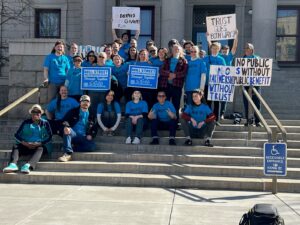
“Historically an affordable place to live, prices in the neighborhood are rising rapidly as upscale development takes over on the south end of downtown. In a 2022 survey of more than 70 Mill Street residents, 58% said they were concerned about being displaced, and pressure has only increased since then,” the Coalition said in a December 2025 statement.
Jariah Walker, executive director of the Colorado Springs Urban Renewal Authority, spoke to council on Feb. 24 about the Moreno and Cascade plan – the second urban renewal plan before council during the meeting. The first, for a multi-family attainable housing project on North Nevada Avenue, passed Council quickly and unanimously.
Walker noted the council had already reviewed the Moreno and Cascade plans, and said he wanted to bring up a few points to answer questions he anticipated the council might have.
“Originally [the Moreno and Cascade Urban Renewal Plan] did not include an attainable housing component at all,” Walker said, explaining that at first there were plans for a commercial component but there was uncertainty about what taxes that would generate, making it less attractive as an urban renewal project. Norwood came to CSURA with the idea for an attainable housing project instead.
He said the Mill Street neighborhood group came to the CSURA board meeting in July 2025 and advocated for affordable, high-density housing as part of the urban renewal project. Walker said he and his board felt it was a good meeting and that everyone was on the same page, and so Norwood and the CSURA moved forward with the project including the attainable housing portion.
“I think we’ve done what the neighborhood has wanted us to do,” Walker said.
The Coalition said publicly last November that talks with Norwood on mitigating impacts to the neighborhood had stalled, as Norwood had ceased communicating, and that the group sought further dialogue.
Defining terms
Walker took issue with the Catbird being described by some as a “luxury hotel” – though he didn’t name names on who called it that.

“It is not a luxury hotel,” he said. “Far from it. These are studio units, some of these units go for 180 bucks a night … this is not a Broadmoor resort or something like that … I don’t think that’s a fair classification and I think it’s a little politically charged, to be quite honest.”

The Pikes Peak Bulletin has called the planned Catbird hotel a luxury hotel. While there is no strict definition for what constitutes a luxury hotel, the Denver Catbird on which the Colorado Springs Catbird will be based advertises its “Luxury Denver Hotel Amenities” and “Luxury Guest Rooms.”
Councilor Henjum asked that council view a slide in the development plan presentation that shows a map of the development area labeled “the New South End.”
“My question is that this map, the New South End, overlaps with what I see as other maps where the Mill Street neighborhood is actually what you’re calling the New South End,” she said, adding, “I think they’re feeling a little bit like they slapped a name on a neighborhood that’s been Mill Street for a very long time. And I want to give you the opportunity to address that because I’m pretty sympathetic to that frustration that they’re experiencing.”
Henjum also brought up the Mill Street Neighborhood Preservation Plan, which was approved by City Council in 2019.
“Was that ever considered in this process at all?” Henjum asked, noting that she has not viewed it herself. “It seems to me that likely should have been considered as part of this process as well.”
Walker explained that the New South End is not an official URA designation but rather a “generic term” used by Norwood, and said that the development addresses concerns about safety and infrastructure raised in the preservation plan, as well as attainable housing.
Public comment
Mill Street resident Susan Adams was the first to give public comment. She said she has lived in the neighborhood for nine years and she likes the transformation she’s witnessed – including the addition of the stadium, and more people out and about enjoying the city – and she thinks the hotel will be a great addition as well. A second speaker, also a neighborhood resident, was similarly in favor, speaking to the economic and social impact of the urban renewal plan, including the jobs that would be created by the hotel, infrastructure improvements such as sidewalks and lighting, and increased tax revenues to support public services.
Resident and Coalition leader Frozie Abbott said she’s lived in Mill Street for more than 23 years.
“A group of us are here today to speak to you about our neighborhood and why we believe we need a legally binding Community Benefits Agreement covering the Catbird hotel development,” she said.
She said Mill Street is Colorado Springs’ oldest working-class neighborhood, and continues to house many of the city’s essential workers. She described a close-knit neighborhood where people look out for each other, and where she maintains a weekly food pantry that provides not only food but social connection.
“I started organizing with my neighbors and our Coalition partners in 2021 because I saw things changing quickly in our neighborhood, and it didn’t seem like as neighbors we had a seat at the table where decisions were being made,” she said. “Many of my neighbors fear being priced or pushed out and I can’t stand for that. If I lose my home, my neighbors, I don’t know what I will do and how I will survive. That’s why we need an agreement with Norwood that creates real solutions.”
Kevin Dexter, owner of Shuga’s restaurant in south downtown, agreed that the neighborhood needed investment, but noted that whenever his business wanted to make a change, “we were required to engage the neighborhood.”
“They had the power to say ‘no’ and if they had, we would not have moved forward,” Dexter said, “That’s not a burden in my opinion; that’s responsible civic process and what it means to build something that belongs in a neighborhood instead of being imposed on one.”
“If a developer wants public dollars, they should first demonstrate good faith collaboration and genuine neighborhood support,” he said.
Catherine Duarte – the senior vice president of housing development at Catholic Charities of Central Colorado and the project manager and co-author of the Mill Street Neighborhood Plan – addressed the council as a Coalition member.
“This city is in an affordable housing crisis,” she said. “We are short attainable units for sure, but we desperately need affordable housing and have very few paths to create it without every level of subsidy available.”
She said the URA and its usage of TIF has “not served residents responsibly or provided a transparent process.”
She said she sees a “lack of concern for the people who live in the so-called blighted area” from the local URA.
“Urban renewal as a practice dates back to the post-World War II years and is notorious for its history of being used to displace entire populations,” she said.
Walker acknowledged that urban renewal does have “a lot of dark history to urban renewal … how it was used in the past.”
“I want everyone in this room to know … that is not what this board or I believe in,” he said. “The goal is not to go into the Mill Street neighborhood, or any neighborhood for that matter, and buy up a bunch of properties to kick a bunch of people out and to develop some huge market-rate housing component … that is gentrification and that’s … something nobody wants to do. That’s not our goal.”
He pointed out that a Community Benefit Agreement is not under CSURA’s purview, and said he is confused why the Coalition did not bring up a CBA at the July CSURA board meeting when the board approved the current plan.
He expressed a willingness to work with the Coalition and on real policy solutions.
“Really what we should be looking at – ‘how do we build in affordability, not just in Mill Street but everywhere?’” he said.
Norwood a hard no on CBA, open to partnership
Norwood Senior Vice President Jeff Finn recalled when Mill Street resident Frozie Abbott, who gave public comment earlier in the meeting, asked him to enter into a Community Benefit Agreement with the Coalition.
Finn remembered, “I said no, I won’t … because you’re not investable … I explained that we look at both our for-profit and nonprofit ventures as investments.”
He said at the time the group wanted $2 million to $3 million to put into a community land trust to ensure housing affordability, though had not formally requested this.
Finn said he wasn’t open to that, but was open to discussions on partnership, which he said occurred and were initially productive – and that he was still open to that discussion after the URA plan was approved.
Henjum asked Finn to state plainly for the record why Norwood will not enter a Community Benefit Agreement with the Mill Street neighborhood.
“We as the development community should not have a gun to our head to work with our neighbor,” Finn said, implying that a CBA felt like a weapon a neighborhood might wield against a large and powerful developer like Norwood – but again expressed willingness to talk with the neighborhood and look for alignment and partnership possibilities after the URA was approved.
“There are some cities [that] actually have in code that a CBA is a requirement of significant developments with URAS – that does happen,” Henjum said. “That’s actually not the city that we live in, y’all. This council is not, I don’t believe at this point in time, would support that. I’m going to stick with reality … the CBA is not something that is realistic at this time.”
Motion to delay fails
Prior to a vote on the Urban Renewal Plan, Donelson made a motion to delay the vote for about a month, until the council meeting after the next one, to give Norwood and the Coalition a chance to resume talks and potentially reach a mutual agreement. That motion failed, with Donelson, Gold, and Henjum voting in favor of tabling the resolution.
Information about Colorado Springs City Council meetings, including agendas and videos of past meetings, is available on the City’s website.