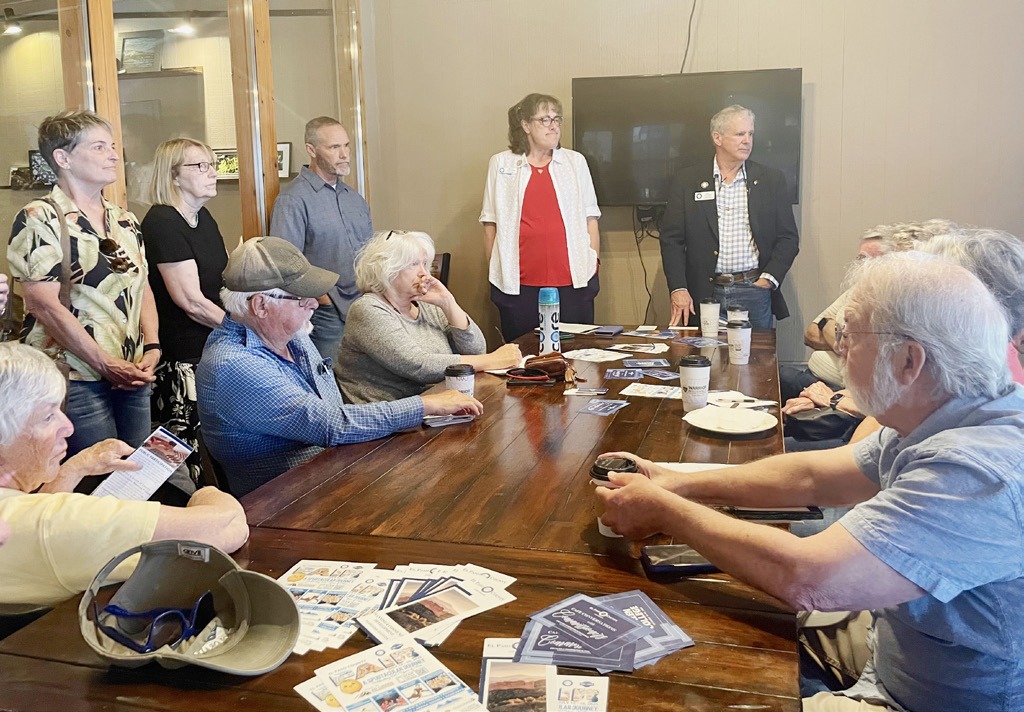
Chris Sorenson feels his “quality of life has gone down a bit here in northern El Paso County, and I feel that it’s the result of excessive growth,” he said at a meet-and-greet in Monument on June 21 with County Commissioners Holly Williams and Bill Wysong.
“It seems that our mission and our vision is to grow at the expense of quality of life,” said Sorenson, who lives in Walden, north of Colorado Springs and east of I-83, where spaces are wide open, homes sit on large lots, and views are Colorado spectacular.
He and dozens of other area residents gathered at Wesley Owens Coffee and Café in Monument to listen to and ask questions of the two commissioners, less than two weeks after some residents in rural eastern El Paso County helped convince voters in Colorado Springs to reject the annexation of three square miles of land known as Karman Line. Opponents argued that the flagpole annexation wasn’t smart growth and would take water from the Lower Arkansas Valley.
El Paso County’s master plan, which aims to balance population growth with environmental conservation and preservation of the healthy, outdoors, tranquil Colorado way of life, helps to preserve the 2 1/2 -acre plots that Sorenson and his neighbors live on, Williams said.
But with the county’s population expected to grow by more than 250,000 over the next 25-30 years, residents’ rights and lifestyles are being “challenged by developers who seem to get their way,” Sorenson said.
In the Flying Horse North development, in Black Forest, for instance, where large lots are the norm, a developer was given the green light to build hundreds of homes, some on lots smaller than one acre; a hotel, condominiums and businesses, said a woman who did not give her name.
All of the commissioners except Longinos Gonzalez, Jr. approved the developer’s plan, the woman said. Williams recused herself from that vote in 2022 on her attorney’s advice after “someone communicated with me … from the developer,” the commissioner said.
She said the county’s 300-year water rule, which requires developers to demonstrate that there is a 300-year supply of water for new subdivisions, helped to “favor larger building lots because you cannot have a huge development with just a 100-year water requirement,” which is the state rule.
Most water providers in unincorporated areas of El Paso County rely on Denver Basin aquifers, which are nonrenewable, for their supply, according to the County’s 2019 Water Master Plan. The 300-year rule was implemented in 1986 to encourage “land developers to bring in additional renewable water sources.”
But Matt Beverly, who grew up in El Paso County and moved back after retiring from the Air Force, said developers “keep finding reasons not to comply with the 300-year rule, or they use the 100-year requirements.”
“There are different rules for commercial development and residential developments, but why are we not all using 300-year water rights … if we’re all pulling from the same sources of water?” he said.
Beverly lives near the land that the town of Palmer Lake wants to annex to allow Texas chain Buc-ee’s to build one of its signature gas station complexes on, known, among other things, for their pristine restrooms – which use a lot of water.
“Annexations … like Buc-ee’s or Karman Line, are tied to water,” Beverly said.
“That impacts me as a county resident, but I don’t have a voice in any town in the area,” including Palmer Lake, he said, before asking the two commissioners what it would take “to get you to help us stand up for proper developments in the area?”
The answers he got – the commissioners would go to meetings and read reports, but once a city launches an initiative, such as annexation, it’s out of the county’s hands – were “disappointing but not surprising,” Beverly told the Pikes Peak Bulletin.
Audience member Nancy Piasecki shared a quote from Williams that was published in April 2024 in “Our Community News,” a newspaper in Monument.
“There’s not as much water as we thought there was,” Williams was quoted as saying.
“I don’t understand how developers can say, ‘We have adequate water for 300 years,’ when we don’t even know what’s in the aquifers,” Piasecki said.
One of several transplants from California at the meeting said he had moved to Colorado to get away from runaway development in southern California, which had caused water and other problems.
“I had people across the street from me in California who said, ‘It’s my water, it’s under my ground, so I can pump as much as I want.’ Until their well ran dry,” he said.
“Don’t think it’s somebody else’s problem. Aquifers don’t comply with state, county or city borders,” he said.
The County will soon conduct a water study, Williams and El Paso County Planning and Community Development Director Meggan Herington said. The Planning Commission is also updating the land development code, and will hold meetings with the community to discuss any changes it makes, Herington said.
I don’t understand how developers can say, ‘We have adequate water for 300 years,’ when we don’t even know what’s in the aquifers. – Nancy Piasecki, El Paso County resident
Wysong, who represents District 3 on the Board of County Commissioners, said balancing growth and quality of life was “very tough.” His district includes the westside and downtown areas of Colorado Springs, the City of Manitou Springs, the towns of Green Mountain Falls, Monument and Palmer Lake, and the unincorporated areas of western El Paso County, including Ute Pass.
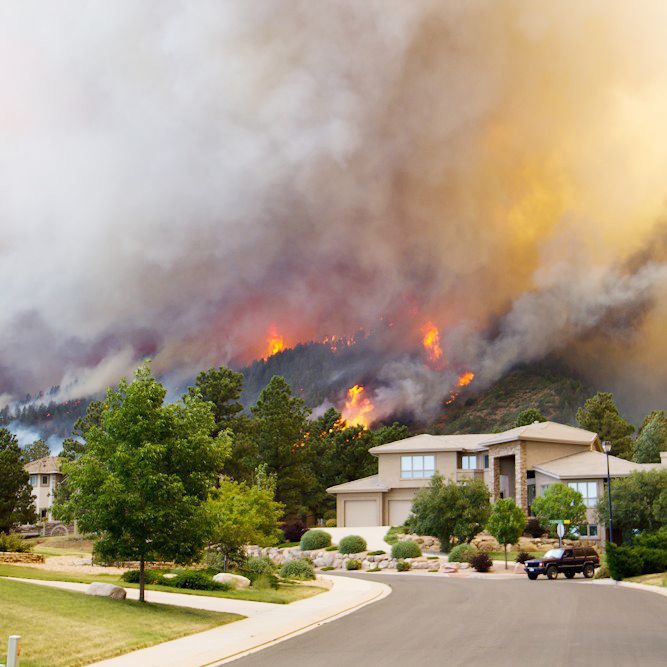
Having survived the 2012 Waldo Canyon fire, which destroyed hundreds of homes in his westside neighborhood and was the most destructive wildfire in Colorado’s history – until the Black Forest surpassed it a year later – Wysong said he understood why dozens of residents had given up part of their Saturday to meet with him and Williams in a packed room at the café.
After Waldo Canyon, “A developer wanted to put 550 apartments in” at an intersection just steps from his neighborhood, he said.
“We got riled up and fought that,” Wysong said.
“I’ve gone through it … I hear what you guys are saying.”